1
2
3
4
5
6
7
8
9
10
11
12
13
14
15
16
17
18
19
20
21
22
23
24
25
26
27
28
29
30
31
32
33
34
35
36
37
38
39
40
41
42
43
44
45
46
47
48
49
50
51
52
53
54
55
56
57
58
59
60
61
62
63
64
65
66
67
68
69
70
71
72
73
74
75
76
77
78
79
80
81
82
83
84
85
86
87
88
89
90
91
92
93
94
95
96
97
98
99
100
101
102
103
104
105
106
107
108
109
110
111
112
113
114
115
116
117
118
119
120
121
122
123
124
125
126
127
128
129
130
131
132
133
134
135
136
137
138
139
140
141
142
143
144
145
146
147
148
149
150
151
152
153
154
155
156
157
158
159
160
161
162
163
164
165
166
167
168
169
170
171
172
173
174
175
176
177
178
179
180
181
182
183
184
185
186
187
188
189
190
191
192
193
194
195
196
197
198
199
200
201
202
203
204
205
206
207
208
209
210
211
212
213
214
215
216
217
218
219
220
221
222
223
224
225
226
227
228
229
230
231
232
233
234
235
236
237
238
239
240
241
242
243
244
245
246
247
248
249
250
251
252
253
254
255
256
257
258
259
260
261
262
263
264
265
266
267
268
269
270
271
272
273
274
275
276
277
278
279
280
281
282
283
284
285
286
287
288
289
290
291
292
293
294
295
296
297
298
299
300
301
302
303
304
305
306
307
308
309
310
311
312
313
314
315
316
317
318
319
320
321
322
323
324
325
326
327
328
329
330
331
332
333
334
335
336
337
338
339
340
341
342
343
344
345
346
347
348
349
350
351
352
353
354
355
356
357
358
359
360
361
362
363
364
365
366
367
368
369
370
371
372
373
374
375
376
377
378
379
380
381
382
383
384
385
386
387
388
389
390
391
392
393
394
395
396
397
398
399
400
401
402
403
404
405
406
407
408
409
410
411
412
413
414
415
416
417
418
419
420
421
422
423
424
425
426
427
428
429
430
431
432
433
434
435
436
437
438
439
440
441
442
443
444
445
446
447
448
449
450
451
452
453
454
455
|
import numpy as np
import matplotlib.pyplot as plt
import matplotlib.gridspec as gridspec
from mpl_toolkits.mplot3d import Axes3D
from mpl_toolkits.mplot3d.art3d import Poly3DCollection
from scipy.optimize import minimize, minimize_scalar
from scipy.interpolate import splprep, splev
import warnings
warnings.filterwarnings('ignore')
plt.rcParams.update({
'figure.facecolor': '#0f0f1a',
'axes.facecolor': '#0f0f1a',
'axes.edgecolor': '#444466',
'axes.labelcolor': '#ccccee',
'xtick.color': '#ccccee',
'ytick.color': '#ccccee',
'text.color': '#eeeeff',
'grid.color': '#222244',
'grid.linestyle': '--',
'grid.alpha': 0.5,
'font.family': 'DejaVu Sans',
})
GOLD = '#f5c842'
CYAN = '#42d4f5'
PINK = '#f542a4'
GREEN = '#42f5a4'
ORANGE = '#f5843c'
WHITE = '#eeeeff'
def rectangle_perimeter(x, area=1.0):
"""Perimeter of rectangle with side x and area fixed."""
if x <= 0:
return np.inf
y = area / x
return 2 * (x + y)
def solve_rectangle(area=1.0):
result = minimize_scalar(
rectangle_perimeter,
bounds=(1e-6, 100),
args=(area,),
method='bounded'
)
x_opt = result.x
y_opt = area / x_opt
L_opt = result.fun
return x_opt, y_opt, L_opt
def regular_ngon_perimeter(n, area=1.0):
"""
Regular n-gon with fixed area A.
Side length s, area = (n * s^2) / (4 * tan(pi/n))
=> s = sqrt(4*A*tan(pi/n)/n)
Perimeter = n * s
"""
tan_val = np.tan(np.pi / n)
s = np.sqrt(4 * area * tan_val / n)
return n * s
def circle_perimeter(area=1.0):
"""Perimeter of circle with given area."""
r = np.sqrt(area / np.pi)
return 2 * np.pi * r
def polygon_area_perimeter(points):
"""Shoelace formula for area; sum of edge lengths for perimeter."""
x, y = points[:, 0], points[:, 1]
n = len(x)
area = 0.5 * abs(
np.dot(x, np.roll(y, -1)) - np.dot(y, np.roll(x, -1))
)
dx = np.diff(np.append(x, x[0]))
dy = np.diff(np.append(y, y[0]))
perim = np.sum(np.sqrt(dx**2 + dy**2))
return area, perim
def optimize_shape(n_pts=32, target_area=1.0):
"""
Optimize radii of n_pts control points on a star-polygon
to minimize perimeter while keeping area = target_area.
"""
theta = np.linspace(0, 2 * np.pi, n_pts, endpoint=False)
def objective(radii):
x = radii * np.cos(theta)
y = radii * np.sin(theta)
pts = np.column_stack([x, y])
_, perim = polygon_area_perimeter(pts)
return perim
def area_constraint(radii):
x = radii * np.cos(theta)
y = radii * np.sin(theta)
pts = np.column_stack([x, y])
area, _ = polygon_area_perimeter(pts)
return area - target_area
r0 = np.full(n_pts, np.sqrt(target_area / np.pi))
r0 += 0.15 * np.random.randn(n_pts)
r0 = np.abs(r0)
constraints = {'type': 'eq', 'fun': area_constraint}
bounds = [(0.01, 10.0)] * n_pts
result = minimize(
objective, r0,
method='SLSQP',
bounds=bounds,
constraints=constraints,
options={'ftol': 1e-9, 'maxiter': 2000}
)
return result, theta
def box_surface_area(dims, volume=1.0):
"""Surface area of box with dimensions dims = [a, b, c]."""
a, b, c = dims
if a <= 0 or b <= 0 or c <= 0:
return np.inf
return 2 * (a*b + b*c + a*c)
def solve_box(volume=1.0):
"""Minimize surface area of box with fixed volume."""
def objective(dims):
return box_surface_area(dims, volume)
def vol_constraint(dims):
return dims[0] * dims[1] * dims[2] - volume
d0 = [volume**(1/3)] * 3
constraints = {'type': 'eq', 'fun': vol_constraint}
bounds = [(1e-4, 10.0)] * 3
result = minimize(
objective, d0,
method='SLSQP',
bounds=bounds,
constraints=constraints,
options={'ftol': 1e-10, 'maxiter': 3000}
)
return result
np.random.seed(42)
x_opt, y_opt, L_rect_opt = solve_rectangle(area=1.0)
x_vals = np.linspace(0.05, 5, 400)
L_rect_vals = [rectangle_perimeter(x) for x in x_vals]
L_circle = circle_perimeter(area=1.0)
print("=" * 55)
print("SECTION 1: Rectangle with Area = 1")
print(f" Optimal sides : {x_opt:.6f} x {y_opt:.6f}")
print(f" Min perimeter : {L_rect_opt:.6f}")
print(f" Circle perim : {L_circle:.6f} (theoretical minimum)")
print(f" Ratio L/L_circ: {L_rect_opt/L_circle:.6f}")
ns = np.arange(3, 201)
perims_ngon = [regular_ngon_perimeter(n) for n in ns]
L_circ = circle_perimeter(area=1.0)
print("\nSECTION 2: n-gon perimeter (area = 1)")
for n in [3, 4, 6, 12, 50, 100, 200]:
p = regular_ngon_perimeter(n)
print(f" n={n:4d}: perimeter={p:.6f} ratio={p/L_circ:.6f}")
print(f" Circle: perimeter={L_circ:.6f} ratio=1.000000")
result_shape, theta_opt = optimize_shape(n_pts=64, target_area=1.0)
radii_opt = np.abs(result_shape.x)
x_shape = radii_opt * np.cos(theta_opt)
y_shape = radii_opt * np.sin(theta_opt)
x_shape_c = np.append(x_shape, x_shape[0])
y_shape_c = np.append(y_shape, y_shape[0])
pts_opt = np.column_stack([x_shape, y_shape])
area_opt, perim_opt = polygon_area_perimeter(pts_opt)
theta_circ = np.linspace(0, 2*np.pi, 300)
r_circ = np.sqrt(1.0 / np.pi)
x_circ = r_circ * np.cos(theta_circ)
y_circ = r_circ * np.sin(theta_circ)
print("\nSECTION 3: Numerical shape optimization")
print(f" Optimized area : {area_opt:.6f} (target=1.0)")
print(f" Optimized perimeter : {perim_opt:.6f}")
print(f" Circle perimeter : {L_circ:.6f}")
print(f" Convergence ratio : {perim_opt/L_circ:.6f}")
result_box = solve_box(volume=1.0)
a_opt, b_opt, c_opt = result_box.x
SA_opt = result_box.fun
SA_sphere = (36 * np.pi * 1.0**2) ** (1/3)
SA_cube = 6 * 1.0**(2/3)
print("\nSECTION 4: Box with Volume = 1")
print(f" Optimal dims : {a_opt:.6f} x {b_opt:.6f} x {c_opt:.6f}")
print(f" Min surf area : {SA_opt:.6f}")
print(f" Cube SA (6) : {SA_cube:.6f} (analytical)")
print(f" Sphere SA : {SA_sphere:.6f} (global minimum)")
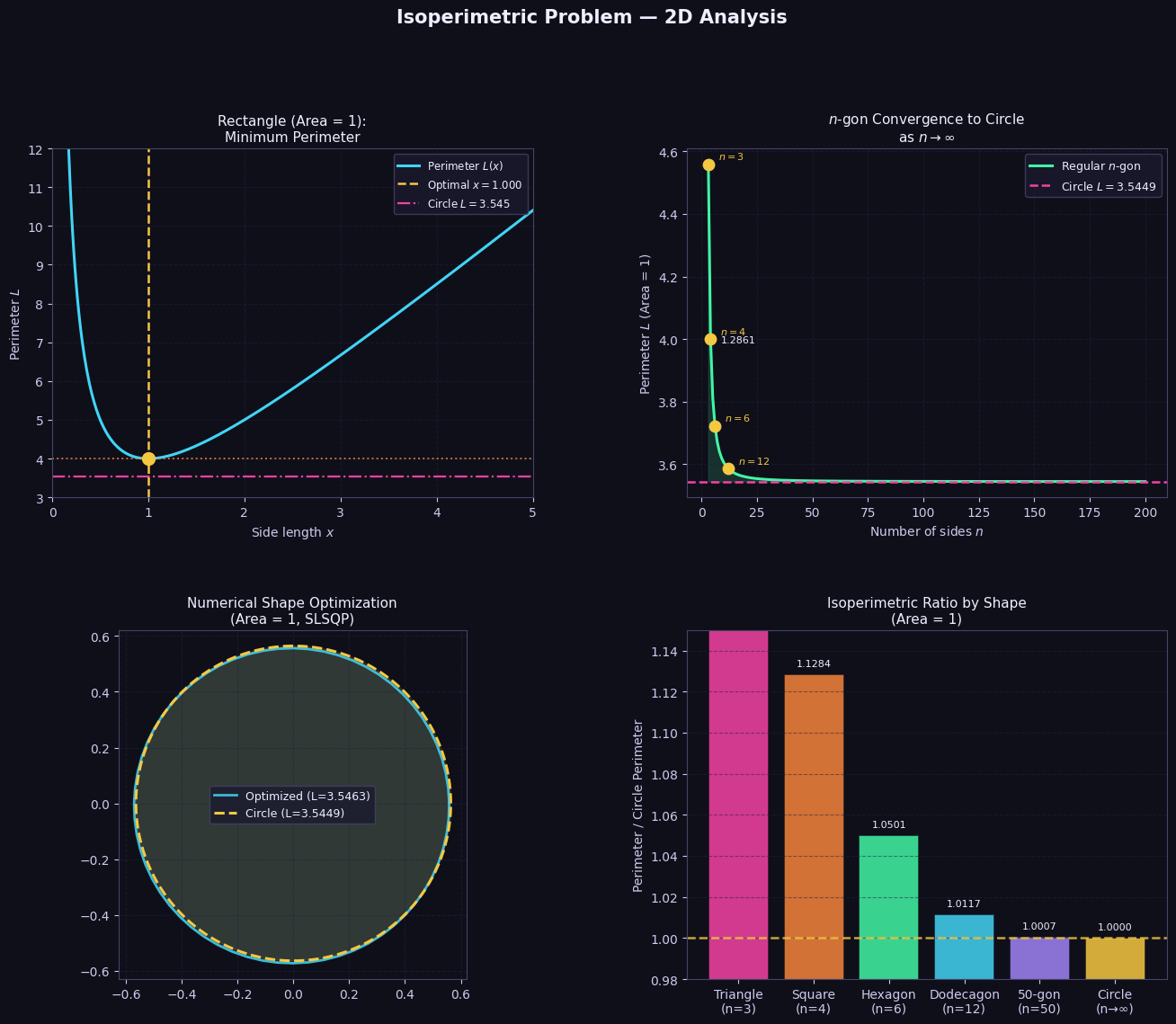
fig1 = plt.figure(figsize=(16, 12))
fig1.patch.set_facecolor('#0f0f1a')
gs = gridspec.GridSpec(2, 2, figure=fig1, hspace=0.38, wspace=0.32)
ax1 = fig1.add_subplot(gs[0, 0])
ax1.plot(x_vals, L_rect_vals, color=CYAN, lw=2.2, label='Perimeter $L(x)$')
ax1.axvline(x_opt, color=GOLD, lw=1.8, ls='--', label=f'Optimal $x={x_opt:.3f}$')
ax1.axhline(L_rect_opt, color=ORANGE, lw=1.4, ls=':', alpha=0.8)
ax1.scatter([x_opt], [L_rect_opt], color=GOLD, s=100, zorder=5)
ax1.axhline(L_circle, color=PINK, lw=1.6, ls='-.', label=f'Circle $L={L_circle:.3f}$')
ax1.set_xlim(0, 5)
ax1.set_ylim(3.0, 12)
ax1.set_xlabel('Side length $x$')
ax1.set_ylabel('Perimeter $L$')
ax1.set_title('Rectangle (Area = 1):\nMinimum Perimeter', color=WHITE, fontsize=11)
ax1.legend(fontsize=8.5, facecolor='#1a1a2e', edgecolor='#444466')
ax1.grid(True)
ax2 = fig1.add_subplot(gs[0, 1])
ax2.plot(ns, perims_ngon, color=GREEN, lw=2.2, label='Regular $n$-gon')
ax2.axhline(L_circ, color=PINK, lw=1.8, ls='--', label=f'Circle $L={L_circ:.4f}$')
ax2.fill_between(ns, perims_ngon, L_circ, alpha=0.15, color=GREEN)
highlight_ns = [3, 4, 6, 12]
highlight_ps = [regular_ngon_perimeter(n) for n in highlight_ns]
ax2.scatter(highlight_ns, highlight_ps, color=GOLD, s=80, zorder=5)
for n, p in zip(highlight_ns, highlight_ps):
ax2.annotate(f'$n={n}$', (n, p), textcoords='offset points',
xytext=(8, 4), color=GOLD, fontsize=8)
ax2.set_xlabel('Number of sides $n$')
ax2.set_ylabel('Perimeter $L$ (Area = 1)')
ax2.set_title('$n$-gon Convergence to Circle\nas $n \\to \\infty$', color=WHITE, fontsize=11)
ax2.legend(fontsize=9, facecolor='#1a1a2e', edgecolor='#444466')
ax2.grid(True)
ax3 = fig1.add_subplot(gs[1, 0])
ax3.plot(x_shape_c, y_shape_c, color=CYAN, lw=2.0, label=f'Optimized (L={perim_opt:.4f})', alpha=0.85)
ax3.plot(x_circ, y_circ, color=GOLD, lw=2.2, ls='--', label=f'Circle (L={L_circ:.4f})')
ax3.fill(x_shape_c, y_shape_c, alpha=0.12, color=CYAN)
ax3.fill(x_circ, y_circ, alpha=0.12, color=GOLD)
ax3.set_aspect('equal')
ax3.set_title('Numerical Shape Optimization\n(Area = 1, SLSQP)', color=WHITE, fontsize=11)
ax3.legend(fontsize=9, facecolor='#1a1a2e', edgecolor='#444466')
ax3.grid(True)
ax4 = fig1.add_subplot(gs[1, 1])
shapes = ['Triangle\n(n=3)', 'Square\n(n=4)', 'Hexagon\n(n=6)', 'Dodecagon\n(n=12)',
'50-gon\n(n=50)', 'Circle\n(n→∞)']
perims_bar = [regular_ngon_perimeter(n) for n in [3, 4, 6, 12, 50]] + [L_circ]
ratios = [p / L_circ for p in perims_bar]
colors_bar = [PINK, ORANGE, GREEN, CYAN, '#a084f5', GOLD]
bars = ax4.bar(shapes, ratios, color=colors_bar, alpha=0.85, edgecolor='#0f0f1a', linewidth=1.2)
ax4.axhline(1.0, color=GOLD, lw=1.8, ls='--', alpha=0.8)
for bar, ratio in zip(bars, ratios):
ax4.text(bar.get_x() + bar.get_width()/2, ratio + 0.003,
f'{ratio:.4f}', ha='center', va='bottom', fontsize=8, color=WHITE)
ax4.set_ylabel('Perimeter / Circle Perimeter')
ax4.set_title('Isoperimetric Ratio by Shape\n(Area = 1)', color=WHITE, fontsize=11)
ax4.set_ylim(0.98, 1.15)
ax4.grid(True, axis='y')
fig1.suptitle('Isoperimetric Problem — 2D Analysis', color=WHITE, fontsize=15, fontweight='bold', y=1.01)
plt.savefig('isoperimetric_2d.png', dpi=150, bbox_inches='tight', facecolor='#0f0f1a')
plt.show()
print("\n[Figure 1 — 2D results displayed above]")
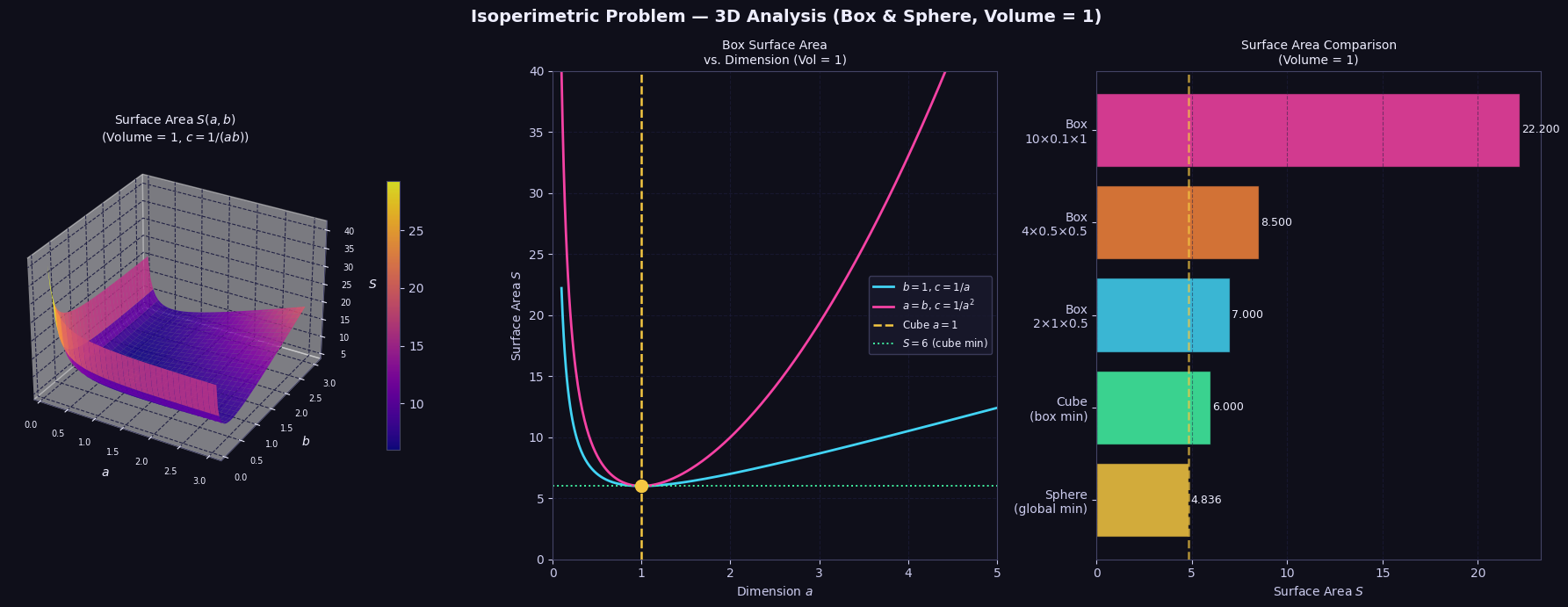
fig2 = plt.figure(figsize=(18, 7))
fig2.patch.set_facecolor('#0f0f1a')
ax5 = fig2.add_subplot(131, projection='3d')
a_range = np.linspace(0.1, 3.0, 60)
b_range = np.linspace(0.1, 3.0, 60)
A_grid, B_grid = np.meshgrid(a_range, b_range)
C_grid = 1.0 / (A_grid * B_grid)
SA_grid = 2 * (A_grid*B_grid + B_grid*C_grid + A_grid*C_grid)
surf = ax5.plot_surface(A_grid, B_grid, SA_grid, cmap='plasma',
alpha=0.88, linewidth=0, antialiased=True)
ax5.scatter([1], [1], [6], color=GOLD, s=120, zorder=10, label='Cube (min)')
ax5.set_xlabel('$a$', color=WHITE)
ax5.set_ylabel('$b$', color=WHITE)
ax5.set_zlabel('$S$', color=WHITE)
ax5.set_title('Surface Area $S(a,b)$\n(Volume = 1, $c=1/(ab)$)', color=WHITE, fontsize=10)
ax5.tick_params(colors=WHITE, labelsize=7)
ax5.set_facecolor('#0f0f1a')
fig2.colorbar(surf, ax=ax5, shrink=0.55, pad=0.1)
ax6 = fig2.add_subplot(132)
a_vals = np.linspace(0.1, 5.0, 400)
SA_b1 = [2*(a*1 + 1*(1/a) + a*(1/a)) for a in a_vals]
SA_sq = [2*(a**2 + a*(1/a**2) + a*(1/a**2)) for a in a_vals]
ax6.plot(a_vals, SA_b1, color=CYAN, lw=2.0, label='$b=1$, $c=1/a$')
ax6.plot(a_vals, SA_sq, color=PINK, lw=2.0, label='$a=b$, $c=1/a^2$')
ax6.axvline(1.0, color=GOLD, lw=1.8, ls='--', label='Cube $a=1$')
ax6.axhline(6.0, color=GREEN, lw=1.4, ls=':', label='$S=6$ (cube min)')
ax6.scatter([1], [6], color=GOLD, s=100, zorder=6)
ax6.set_xlim(0, 5)
ax6.set_ylim(0, 40)
ax6.set_xlabel('Dimension $a$')
ax6.set_ylabel('Surface Area $S$')
ax6.set_title('Box Surface Area\nvs. Dimension (Vol = 1)', color=WHITE, fontsize=10)
ax6.legend(fontsize=8.5, facecolor='#1a1a2e', edgecolor='#444466')
ax6.grid(True)
ax7 = fig2.add_subplot(133)
categories = ['Sphere\n(global min)', 'Cube\n(box min)', 'Box\n2×1×0.5', 'Box\n4×0.5×0.5',
'Box\n10×0.1×1']
volumes = [1.0, 1.0, 1.0, 1.0, 1.0]
r_sphere = (3/(4*np.pi))**(1/3)
SA_sphere_val = 4 * np.pi * r_sphere**2
SA_values = [
SA_sphere_val,
6.0,
2*(2*1 + 1*0.5 + 2*0.5),
2*(4*0.5 + 0.5*0.5 + 4*0.5),
2*(10*0.1 + 0.1*1 + 10*1),
]
colors_c = [GOLD, GREEN, CYAN, ORANGE, PINK]
bars2 = ax7.barh(categories, SA_values, color=colors_c, alpha=0.85,
edgecolor='#0f0f1a', linewidth=1.0)
ax7.axvline(SA_sphere_val, color=GOLD, lw=1.8, ls='--', alpha=0.7)
for bar, val in zip(bars2, SA_values):
ax7.text(val + 0.1, bar.get_y() + bar.get_height()/2,
f'{val:.3f}', va='center', fontsize=9, color=WHITE)
ax7.set_xlabel('Surface Area $S$')
ax7.set_title('Surface Area Comparison\n(Volume = 1)', color=WHITE, fontsize=10)
ax7.grid(True, axis='x')
fig2.suptitle('Isoperimetric Problem — 3D Analysis (Box & Sphere, Volume = 1)',
color=WHITE, fontsize=14, fontweight='bold')
plt.tight_layout()
plt.savefig('isoperimetric_3d.png', dpi=150, bbox_inches='tight', facecolor='#0f0f1a')
plt.show()
print("\n[Figure 2 — 3D results displayed above]")
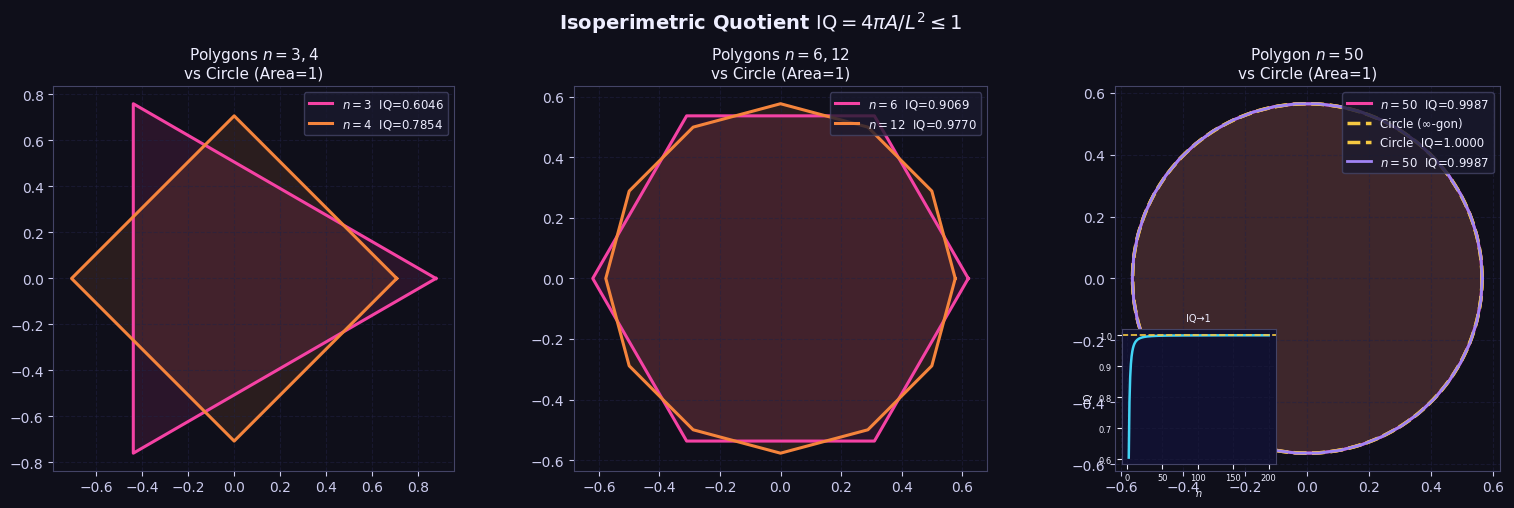
fig3, axes = plt.subplots(1, 3, figsize=(16, 5))
fig3.patch.set_facecolor('#0f0f1a')
for ax in axes:
ax.set_facecolor('#0f0f1a')
theta_full = np.linspace(0, 2*np.pi, 500)
for ax_idx, n_list in enumerate([[3, 4], [6, 12], [50, None]]):
ax = axes[ax_idx]
palette = [PINK, ORANGE, GREEN, CYAN, '#a084f5', GOLD]
for k, n in enumerate(n_list):
if n is None:
xc = r_circ * np.cos(theta_full)
yc = r_circ * np.sin(theta_full)
ax.plot(xc, yc, color=GOLD, lw=2.5, label='Circle (∞-gon)', ls='--')
ax.fill(xc, yc, alpha=0.1, color=GOLD)
else:
theta_n = np.linspace(0, 2*np.pi, n+1)
tan_v = np.tan(np.pi / n)
s = np.sqrt(4 * tan_v / n)
R = s / (2 * np.sin(np.pi / n))
xn = R * np.cos(theta_n)
yn = R * np.sin(theta_n)
col = palette[k]
IQ = 4 * np.pi * 1.0 / regular_ngon_perimeter(n)**2
ax.plot(xn, yn, color=col, lw=2.2, label=f'$n={n}$ IQ={IQ:.4f}')
ax.fill(xn, yn, alpha=0.12, color=col)
if n_list[1] is None:
IQ_circ = 4 * np.pi * 1.0 / L_circ**2
ax.plot(r_circ * np.cos(theta_full), r_circ * np.sin(theta_full),
color=GOLD, lw=2.5, ls='--', label=f'Circle IQ={IQ_circ:.4f}')
n_draw = 50
tan_v = np.tan(np.pi / n_draw)
s = np.sqrt(4 * tan_v / n_draw)
R = s / (2 * np.sin(np.pi / n_draw))
theta_n = np.linspace(0, 2*np.pi, n_draw+1)
xn = R * np.cos(theta_n); yn = R * np.sin(theta_n)
IQ50 = 4 * np.pi * 1.0 / regular_ngon_perimeter(50)**2
ax.plot(xn, yn, color='#a084f5', lw=2.0, label=f'$n=50$ IQ={IQ50:.4f}')
ax.set_aspect('equal')
ax.grid(True)
ax.legend(fontsize=8.5, facecolor='#1a1a2e', edgecolor='#444466', loc='upper right')
axes[0].set_title('Polygons $n=3,4$\nvs Circle (Area=1)', color=WHITE, fontsize=11)
axes[1].set_title('Polygons $n=6,12$\nvs Circle (Area=1)', color=WHITE, fontsize=11)
axes[2].set_title('Polygon $n=50$\nvs Circle (Area=1)', color=WHITE, fontsize=11)
from mpl_toolkits.axes_grid1.inset_locator import inset_axes
ax_ins = inset_axes(axes[2], width='40%', height='35%', loc='lower left')
ax_ins.set_facecolor('#111130')
IQ_vals = [4 * np.pi * 1.0 / regular_ngon_perimeter(n)**2 for n in ns]
ax_ins.plot(ns, IQ_vals, color=CYAN, lw=1.8)
ax_ins.axhline(1.0, color=GOLD, lw=1.2, ls='--')
ax_ins.set_xlabel('$n$', fontsize=7, color=WHITE)
ax_ins.set_ylabel('IQ', fontsize=7, color=WHITE)
ax_ins.set_title('IQ→1', fontsize=7, color=WHITE)
ax_ins.tick_params(colors=WHITE, labelsize=6)
ax_ins.grid(True, alpha=0.3)
fig3.suptitle('Isoperimetric Quotient $\\mathrm{IQ} = 4\\pi A / L^2 \\leq 1$',
color=WHITE, fontsize=14, fontweight='bold')
plt.tight_layout()
plt.savefig('isoperimetric_iq.png', dpi=150, bbox_inches='tight', facecolor='#0f0f1a')
plt.show()
print("\n[Figure 3 — Isoperimetric Quotient displayed above]")
|