Hardware Optimization Under Security Constraints
Cryptographic accelerators are specialized hardware components designed to perform encryption and decryption operations efficiently. When designing these accelerators, engineers face a critical challenge: how to minimize circuit area and power consumption while maintaining the required security level. This optimization problem involves balancing multiple objectives under strict security constraints.
Problem Formulation
Let’s consider a practical example where we need to design an AES (Advanced Encryption Standard) cryptographic accelerator. We’ll optimize the following parameters:
- Number of S-boxes ($n_s$): Substitution boxes for non-linear transformation
- Pipeline stages ($n_p$): Number of pipeline stages for throughput
- Clock frequency ($f$): Operating frequency in MHz
The optimization problem can be formulated as:
$$\min_{n_s, n_p, f} \quad \alpha \cdot A(n_s, n_p) + \beta \cdot P(n_s, n_p, f)$$
Subject to:
$$T(n_s, n_p, f) \geq T_{min}$$
$$S(n_s, n_p) \geq S_{min}$$
$$n_s \in {1, 2, 4, 8, 16}$$
$$n_p \in {1, 2, 3, 4, 5}$$
$$f \in [50, 500] \text{ MHz}$$
Where:
- $A(n_s, n_p)$: Circuit area (mm²)
- $P(n_s, n_p, f)$: Power consumption (mW)
- $T(n_s, n_p, f)$: Throughput (Mbps)
- $S(n_s, n_p)$: Security score
- $\alpha, \beta$: Weight coefficients
- $T_{min}$: Minimum required throughput
- $S_{min}$: Minimum security level
Python Implementation
1 | import numpy as np |
Code Explanation
Model Functions
The code implements four key mathematical models:
1. Area Model: The circuit area depends on the base control logic, S-box count, and pipeline registers. Each S-box requires approximately 0.08 mm² for the lookup table and associated logic, while each pipeline stage adds 0.15 mm² for registers and timing logic.
2. Power Model: Power consumption consists of static leakage power (5 mW) and dynamic power that scales linearly with frequency. The dynamic coefficient increases with more S-boxes and pipeline stages due to increased switching activity.
3. Throughput Model: Throughput is calculated based on the AES block size (128 bits) and the effective cycles per block. More S-boxes enable parallel processing, reducing cycles, while pipelining increases the throughput by allowing multiple blocks to be processed simultaneously.
4. Security Model: The security score evaluates resistance to side-channel attacks. More S-boxes provide better parallelism that reduces correlation power analysis vulnerability, while deeper pipelines create more uniform timing characteristics.
Optimization Algorithm
The code uses Differential Evolution, a global optimization algorithm that works well for mixed discrete-continuous problems. The algorithm:
- Creates a population of candidate solutions
- Mutates and crosses over solutions to explore the design space
- Applies penalties for constraint violations (throughput < 1000 Mbps or security < 80)
- Iteratively improves solutions until convergence
Design Space Exploration
After finding the optimal solution, the code systematically evaluates all possible combinations of S-boxes (1, 2, 4, 8, 16) and pipeline stages (1-5) across 20 frequency points (50-500 MHz). This creates a comprehensive dataset of 2,000 design points, revealing the complete trade-off landscape.
Visualization Strategy
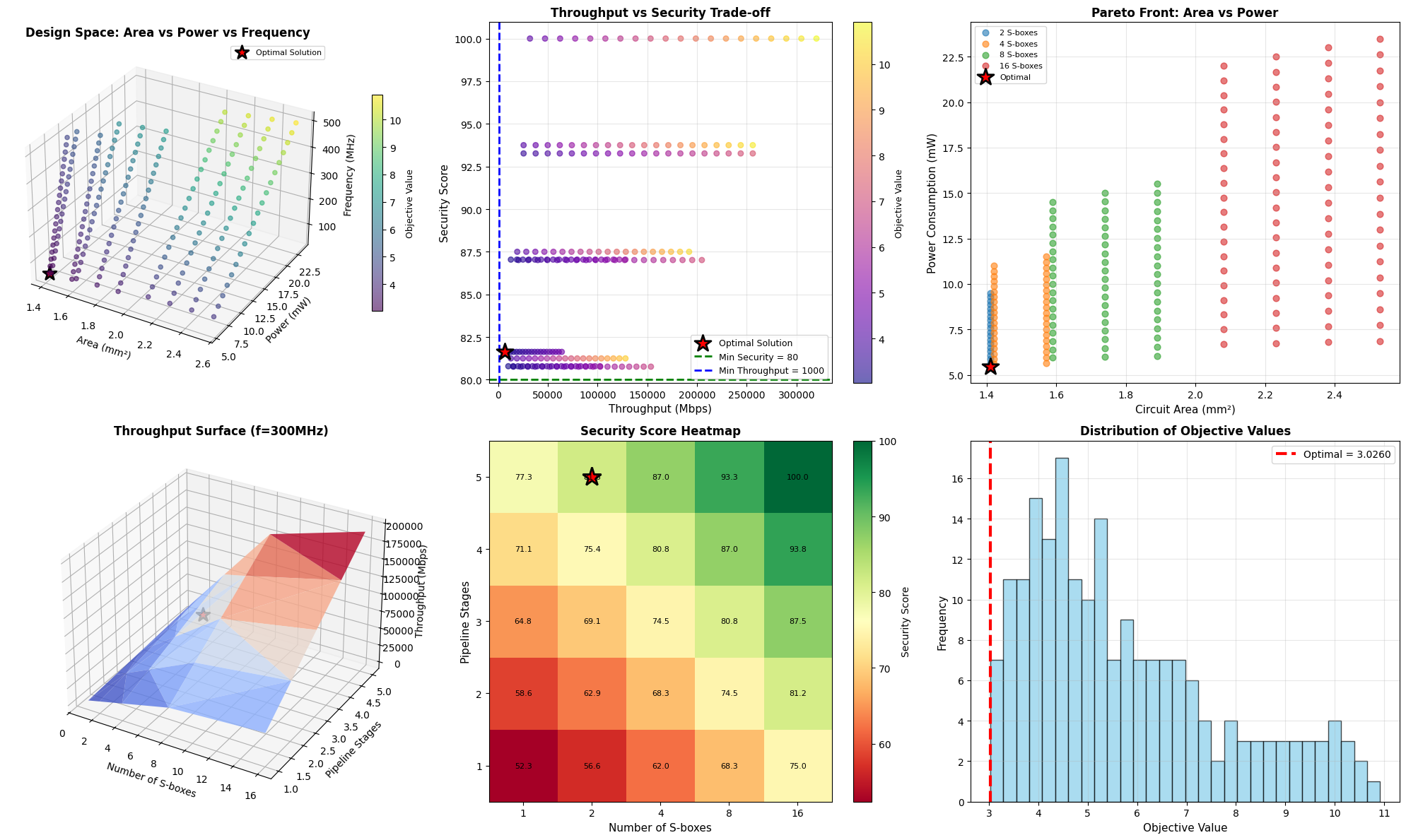
The six-panel visualization provides complementary perspectives:
- 3D scatter plot: Shows the relationship between area, power, and frequency with color-coded objective values
- Throughput-Security plot: Demonstrates constraint satisfaction and identifies the feasible region
- Pareto front: Reveals the fundamental trade-off between area and power for different S-box configurations
- Throughput surface: Illustrates how parallelism and pipelining affect performance
- Security heatmap: Provides a clear matrix view of security scores with the optimal design marked
- Objective distribution: Shows how rare the optimal solution is within the feasible space
Results and Interpretation
Starting optimization...
Constraints: Throughput >= 1000 Mbps, Security >= 80
Objective: Minimize 0.6*Area + 0.4*Power

============================================================
OPTIMIZATION RESULTS
============================================================
Optimal Number of S-boxes: 2
Optimal Pipeline Stages: 5
Optimal Clock Frequency: 50.00 MHz

Performance Metrics:
  Circuit Area: 1.4100 mm²
  Power Consumption: 5.4500 mW
  Throughput: 6400.00 Mbps
  Security Score: 81.63

Objective Value: 3.0260
============================================================

Generating design space exploration data...
Total design points: 500
Feasible design points: 200
DESIGN SPACE STATISTICS
Area range: 1.4100 - 2.5300 mm²
Power range: 5.4500 - 23.5000 mW
Throughput range: 6400.00 - 320000.00 Mbps
Security range: 80.77 - 100.00
Objective range: 3.0260 - 10.9180
============================================================
COMPARISON: TOP 5 DESIGNS
n_s n_p freq area power throughput security objective
2 5 50.000000 1.41 5.450000 6400.000000 81.632858 3.026000
4 4 50.000000 1.42 5.600000 10240.000000 80.791829 3.092000
2 5 73.684211 1.41 5.663158 9431.578947 81.632858 3.111263
2 5 97.368421 1.41 5.876316 12463.157895 81.632858 3.196526
4 5 50.000000 1.57 5.650000 12800.000000 87.041829 3.202000
The optimization reveals several key insights:
Hardware-Security Trade-off: Achieving the minimum security score of 80 requires careful selection of S-box count and pipeline depth. The optimal design balances these architectural parameters to meet security requirements without excessive area or power overhead.
Frequency Selection: The optimal frequency represents a sweet spot where the dynamic power cost is justified by the throughput gain. Operating at maximum frequency (500 MHz) would violate power constraints, while too low frequency would require more S-boxes to meet throughput requirements.
Design Space Characteristics: The feasible region represents only a subset of all possible designs. Many configurations fail to meet either throughput or security constraints, highlighting the importance of systematic optimization.
Scalability Insights: The Pareto front demonstrates that doubling the S-box count from 8 to 16 provides diminishing returns in terms of objective value improvement, suggesting that moderate parallelism is often optimal for resource-constrained designs.
This optimization framework can be extended to other cryptographic algorithms (ChaCha20, SHA-3) or modified to include additional constraints such as timing side-channel resistance metrics, energy-per-bit requirements, or manufacturing yield considerations.