Minimizing Gap Bounds in the Twin Prime Problem

A Concrete Python Exploration

The twin prime conjecture is one of the most tantalizing unsolved problems in number theory. It asserts that there are infinitely many prime pairs $(p, p+2)$. While no one has proven it yet, mathematicians have made spectacular progress in bounding the gap between consecutive primes. In this post, weโ€™ll dig into what โ€œgap upper bound minimizationโ€ actually means, walk through a concrete example, implement it in Python, and visualize the results โ€” including in 3D.


๐Ÿงฎ Background: What Is the Gap Bound Problem?

Let $p_n$ denote the $n$-th prime. Define the prime gap as:

$$g_n = p_{n+1} - p_n$$

The twin prime conjecture is equivalent to saying:

$$\liminf_{n \to \infty} g_n = 2$$

For many decades, all we could prove was:

$$\liminf_{n \to \infty} g_n < \infty$$

In 2013, Yitang Zhang shocked the world by proving:

$$\liminf_{n \to \infty} g_n \leq 70{,}000{,}000$$

The Polymath8 project then dramatically reduced this bound. By optimizing the sieve weights (a process called gap upper bound minimization), the bound was pushed down to:

$$\liminf_{n \to \infty} g_n \leq 246$$

Our goal here is to computationally explore and minimize the observed prime gap upper bound over a finite range, using the admissible $k$-tuple framework and gap analysis โ€” a concrete analogue of the theoretical machinery.


๐ŸŽฏ Concrete Problem Statement

Problem: Over all primes $p \leq N$ (weโ€™ll use $N = 10^6$), find:

  1. The distribution of prime gaps $g_n = p_{n+1} - p_n$
  2. The smallest observed maximum gap in any window of $W$ consecutive primes
  3. The densest admissible $k$-tuples of the form ${0, d_1, d_2, \ldots, d_{k-1}}$ with all differences $\leq B$ for a bound $B$
  4. Visualize gap structure in 2D and 3D

๐Ÿ Python Source Code

1
2
3
4
5
6
7
8
9
10
11
12
13
14
15
16
17
18
19
20
21
22
23
24
25
26
27
28
29
30
31
32
33
34
35
36
37
38
39
40
41
42
43
44
45
46
47
48
49
50
51
52
53
54
55
56
57
58
59
60
61
62
63
64
65
66
67
68
69
70
71
72
73
74
75
76
77
78
79
80
81
82
83
84
85
86
87
88
89
90
91
92
93
94
95
96
97
98
99
100
101
102
103
104
105
106
107
108
109
110
111
112
113
114
115
116
117
118
119
120
121
122
123
124
125
126
127
128
129
130
131
132
133
134
135
136
137
138
139
140
141
142
143
144
145
146
147
148
149
150
151
152
153
154
155
156
157
158
159
160
161
162
163
164
165
166
167
168
169
170
171
172
173
174
175
176
177
178
179
180
181
182
183
184
185
186
187
188
189
190
191
192
193
194
195
196
197
198
199
200
201
202
203
204
205
206
207
208
209
210
211
212
213
214
215
216
217
218
219
220
221
222
223
224
225
226
227
228
229
230
231
232
233
234
235
236
237
238
239
240
241
242
243
244
245
246
247
248
249
250
251
252
253
254
255
256
257
258
259
260
261
262
263
264
265
266
267
268
269
270
271
272
273
274
275
276
277
278
279
280
281
282
283
284
285
286
287
288
289
290
291
292
293
294
295
296
297
298
299
300
301
302
303
304
305
306
307
308
309
310
311
312
313
314
315
316
317
318
319
320
321
322
323
324
325
326
327
328
329
330
331
332
333
334
335
336
337
338
339
340
341
342
343
344
345
346
347
348
349
350
351
352
353
# ============================================================
# Twin Prime Gap Upper Bound Minimization
# Concrete Example with Visualization (2D + 3D)
# ============================================================

import numpy as np
import matplotlib.pyplot as plt
from mpl_toolkits.mplot3d import Axes3D
from itertools import combinations
import time

# โ”€โ”€โ”€โ”€โ”€โ”€โ”€โ”€โ”€โ”€โ”€โ”€โ”€โ”€โ”€โ”€โ”€โ”€โ”€โ”€โ”€โ”€โ”€โ”€โ”€โ”€โ”€โ”€โ”€โ”€โ”€โ”€โ”€โ”€โ”€โ”€โ”€โ”€โ”€โ”€โ”€โ”€โ”€โ”€โ”€
# 1. Sieve of Eratosthenes (fast NumPy version)
# โ”€โ”€โ”€โ”€โ”€โ”€โ”€โ”€โ”€โ”€โ”€โ”€โ”€โ”€โ”€โ”€โ”€โ”€โ”€โ”€โ”€โ”€โ”€โ”€โ”€โ”€โ”€โ”€โ”€โ”€โ”€โ”€โ”€โ”€โ”€โ”€โ”€โ”€โ”€โ”€โ”€โ”€โ”€โ”€โ”€
def sieve_of_eratosthenes(limit):
"""Return array of primes up to limit using vectorized sieve."""
is_prime = np.ones(limit + 1, dtype=bool)
is_prime[0:2] = False
for i in range(2, int(limit**0.5) + 1):
if is_prime[i]:
is_prime[i*i::i] = False
return np.where(is_prime)[0]

# โ”€โ”€โ”€โ”€โ”€โ”€โ”€โ”€โ”€โ”€โ”€โ”€โ”€โ”€โ”€โ”€โ”€โ”€โ”€โ”€โ”€โ”€โ”€โ”€โ”€โ”€โ”€โ”€โ”€โ”€โ”€โ”€โ”€โ”€โ”€โ”€โ”€โ”€โ”€โ”€โ”€โ”€โ”€โ”€โ”€
# 2. Compute prime gaps
# โ”€โ”€โ”€โ”€โ”€โ”€โ”€โ”€โ”€โ”€โ”€โ”€โ”€โ”€โ”€โ”€โ”€โ”€โ”€โ”€โ”€โ”€โ”€โ”€โ”€โ”€โ”€โ”€โ”€โ”€โ”€โ”€โ”€โ”€โ”€โ”€โ”€โ”€โ”€โ”€โ”€โ”€โ”€โ”€โ”€
def compute_gaps(primes):
"""Compute gaps between consecutive primes."""
return np.diff(primes)

# โ”€โ”€โ”€โ”€โ”€โ”€โ”€โ”€โ”€โ”€โ”€โ”€โ”€โ”€โ”€โ”€โ”€โ”€โ”€โ”€โ”€โ”€โ”€โ”€โ”€โ”€โ”€โ”€โ”€โ”€โ”€โ”€โ”€โ”€โ”€โ”€โ”€โ”€โ”€โ”€โ”€โ”€โ”€โ”€โ”€
# 3. Sliding window: minimum of max-gap
# โ”€โ”€โ”€โ”€โ”€โ”€โ”€โ”€โ”€โ”€โ”€โ”€โ”€โ”€โ”€โ”€โ”€โ”€โ”€โ”€โ”€โ”€โ”€โ”€โ”€โ”€โ”€โ”€โ”€โ”€โ”€โ”€โ”€โ”€โ”€โ”€โ”€โ”€โ”€โ”€โ”€โ”€โ”€โ”€โ”€
def min_max_gap_in_window(gaps, window_size):
"""
For each window of `window_size` consecutive gaps,
compute the max gap. Return the minimum of those maxima.
This is our 'gap upper bound' for the window.
"""
n = len(gaps)
if window_size > n:
return np.max(gaps), 0

# Use sliding window with deque-based approach for speed
from collections import deque
dq = deque()
window_maxes = []

for i in range(n):
# Remove elements outside the window
while dq and dq[0] < i - window_size + 1:
dq.popleft()
# Remove smaller elements (not useful)
while dq and gaps[dq[-1]] <= gaps[i]:
dq.pop()
dq.append(i)

if i >= window_size - 1:
window_maxes.append(gaps[dq[0]])

window_maxes = np.array(window_maxes)
min_val = np.min(window_maxes)
min_idx = np.argmin(window_maxes)
return min_val, min_idx

# โ”€โ”€โ”€โ”€โ”€โ”€โ”€โ”€โ”€โ”€โ”€โ”€โ”€โ”€โ”€โ”€โ”€โ”€โ”€โ”€โ”€โ”€โ”€โ”€โ”€โ”€โ”€โ”€โ”€โ”€โ”€โ”€โ”€โ”€โ”€โ”€โ”€โ”€โ”€โ”€โ”€โ”€โ”€โ”€โ”€
# 4. Admissible k-tuple check
# โ”€โ”€โ”€โ”€โ”€โ”€โ”€โ”€โ”€โ”€โ”€โ”€โ”€โ”€โ”€โ”€โ”€โ”€โ”€โ”€โ”€โ”€โ”€โ”€โ”€โ”€โ”€โ”€โ”€โ”€โ”€โ”€โ”€โ”€โ”€โ”€โ”€โ”€โ”€โ”€โ”€โ”€โ”€โ”€โ”€
def is_admissible(offsets):
"""
A k-tuple H = {h_1, ..., h_k} is admissible if for every prime p,
the set H does not cover all residues mod p.
We check for all primes p <= k+1 (sufficient for small tuples).
"""
k = len(offsets)
check_primes = sieve_of_eratosthenes(max(k + 2, 10))
for p in check_primes:
residues = set(h % p for h in offsets)
if len(residues) == p: # covers all residues mod p
return False
return True

# โ”€โ”€โ”€โ”€โ”€โ”€โ”€โ”€โ”€โ”€โ”€โ”€โ”€โ”€โ”€โ”€โ”€โ”€โ”€โ”€โ”€โ”€โ”€โ”€โ”€โ”€โ”€โ”€โ”€โ”€โ”€โ”€โ”€โ”€โ”€โ”€โ”€โ”€โ”€โ”€โ”€โ”€โ”€โ”€โ”€
# 5. Find densest admissible k-tuple within bound B
# โ”€โ”€โ”€โ”€โ”€โ”€โ”€โ”€โ”€โ”€โ”€โ”€โ”€โ”€โ”€โ”€โ”€โ”€โ”€โ”€โ”€โ”€โ”€โ”€โ”€โ”€โ”€โ”€โ”€โ”€โ”€โ”€โ”€โ”€โ”€โ”€โ”€โ”€โ”€โ”€โ”€โ”€โ”€โ”€โ”€
def find_admissible_tuples(B, k_values):
"""
For each k in k_values, find an admissible k-tuple
{0, d_1, ..., d_{k-1}} with max element <= B.
Returns list of (k, tuple, diameter).
"""
results = []

# Candidate offsets: even numbers + 0 (gaps must be even for twin primes)
# Use a greedy/random search for efficiency
candidates = [0] + list(range(2, B+1, 2))

for k in k_values:
best = None
best_diam = B + 1
count = 0
max_trials = min(2000, len(candidates) ** 2)

# Systematic search for small k
if k <= 4:
for combo in combinations(candidates[:min(30, len(candidates))], k - 1):
offsets = [0] + list(combo)
if max(offsets) <= B and is_admissible(offsets):
diam = max(offsets)
if diam < best_diam:
best_diam = diam
best = offsets
count += 1
if count > max_trials:
break
else:
# For larger k, random sampling
rng = np.random.default_rng(42)
for _ in range(max_trials):
chosen = sorted(rng.choice(candidates[1:], size=k-1, replace=False).tolist())
offsets = [0] + chosen
if max(offsets) <= B and is_admissible(offsets):
diam = max(offsets)
if diam < best_diam:
best_diam = diam
best = offsets

if best is not None:
results.append((k, best, best_diam))

return results

# โ”€โ”€โ”€โ”€โ”€โ”€โ”€โ”€โ”€โ”€โ”€โ”€โ”€โ”€โ”€โ”€โ”€โ”€โ”€โ”€โ”€โ”€โ”€โ”€โ”€โ”€โ”€โ”€โ”€โ”€โ”€โ”€โ”€โ”€โ”€โ”€โ”€โ”€โ”€โ”€โ”€โ”€โ”€โ”€โ”€
# 6. Gap distribution by prime magnitude
# โ”€โ”€โ”€โ”€โ”€โ”€โ”€โ”€โ”€โ”€โ”€โ”€โ”€โ”€โ”€โ”€โ”€โ”€โ”€โ”€โ”€โ”€โ”€โ”€โ”€โ”€โ”€โ”€โ”€โ”€โ”€โ”€โ”€โ”€โ”€โ”€โ”€โ”€โ”€โ”€โ”€โ”€โ”€โ”€โ”€
def gap_distribution_by_segment(primes, gaps, n_segments=10):
"""Split prime range into segments and compute gap stats per segment."""
seg_size = len(primes) // n_segments
seg_data = []
for i in range(n_segments):
start = i * seg_size
end = (i + 1) * seg_size if i < n_segments - 1 else len(gaps)
seg_gaps = gaps[start:end]
seg_primes = primes[start:end]
seg_data.append({
'segment': i + 1,
'prime_range_start': int(primes[start]),
'prime_range_end': int(primes[min(end, len(primes)-1)]),
'mean_gap': float(np.mean(seg_gaps)),
'max_gap': int(np.max(seg_gaps)),
'min_gap': int(np.min(seg_gaps)),
'twin_prime_count': int(np.sum(seg_gaps == 2)),
'center_prime': float(np.mean(seg_primes)),
})
return seg_data

# โ”€โ”€โ”€โ”€โ”€โ”€โ”€โ”€โ”€โ”€โ”€โ”€โ”€โ”€โ”€โ”€โ”€โ”€โ”€โ”€โ”€โ”€โ”€โ”€โ”€โ”€โ”€โ”€โ”€โ”€โ”€โ”€โ”€โ”€โ”€โ”€โ”€โ”€โ”€โ”€โ”€โ”€โ”€โ”€โ”€
# MAIN
# โ”€โ”€โ”€โ”€โ”€โ”€โ”€โ”€โ”€โ”€โ”€โ”€โ”€โ”€โ”€โ”€โ”€โ”€โ”€โ”€โ”€โ”€โ”€โ”€โ”€โ”€โ”€โ”€โ”€โ”€โ”€โ”€โ”€โ”€โ”€โ”€โ”€โ”€โ”€โ”€โ”€โ”€โ”€โ”€โ”€
print("=" * 60)
print(" Twin Prime Gap Upper Bound Minimization")
print("=" * 60)

N = 1_000_000
W_values = [10, 50, 100, 500]

# Step 1: Generate primes
t0 = time.time()
primes = sieve_of_eratosthenes(N)
gaps = compute_gaps(primes)
print(f"\n[1] Primes up to {N:,}: {len(primes):,} primes found ({time.time()-t0:.3f}s)")
print(f" First few primes: {primes[:10]}")
print(f" Largest prime <= {N}: {primes[-1]}")

# Step 2: Sliding window gap bound
print("\n[2] Sliding Window โ€” Minimum of Max-Gap:")
window_results = []
for W in W_values:
val, idx = min_max_gap_in_window(gaps, W)
start_prime = int(primes[idx])
end_prime = int(primes[idx + W])
window_results.append((W, val, start_prime, end_prime))
print(f" W={W:4d}: min(max-gap) = {val:3d} "
f"[primes {start_prime:,} to {end_prime:,}]")

# Step 3: Admissible k-tuples
print("\n[3] Densest Admissible k-Tuples (B=100):")
B = 100
k_values = [2, 3, 4, 5, 6]
tuple_results = find_admissible_tuples(B, k_values)
for k, tup, diam in tuple_results:
print(f" k={k}: {tup} diameter={diam}")

# Step 4: Gap distribution by segment
print("\n[4] Gap Statistics by Prime Segment:")
seg_data = gap_distribution_by_segment(primes, gaps, n_segments=10)
print(f" {'Seg':>4} {'Range Start':>12} {'Range End':>10} "
f"{'Mean Gap':>9} {'Max Gap':>8} {'Twin Primes':>11}")
for s in seg_data:
print(f" {s['segment']:>4} {s['prime_range_start']:>12,} "
f"{s['prime_range_end']:>10,} {s['mean_gap']:>9.2f} "
f"{s['max_gap']:>8} {s['twin_prime_count']:>11}")

# โ”€โ”€โ”€โ”€โ”€โ”€โ”€โ”€โ”€โ”€โ”€โ”€โ”€โ”€โ”€โ”€โ”€โ”€โ”€โ”€โ”€โ”€โ”€โ”€โ”€โ”€โ”€โ”€โ”€โ”€โ”€โ”€โ”€โ”€โ”€โ”€โ”€โ”€โ”€โ”€โ”€โ”€โ”€โ”€โ”€
# 7. VISUALIZATION
# โ”€โ”€โ”€โ”€โ”€โ”€โ”€โ”€โ”€โ”€โ”€โ”€โ”€โ”€โ”€โ”€โ”€โ”€โ”€โ”€โ”€โ”€โ”€โ”€โ”€โ”€โ”€โ”€โ”€โ”€โ”€โ”€โ”€โ”€โ”€โ”€โ”€โ”€โ”€โ”€โ”€โ”€โ”€โ”€โ”€
fig = plt.figure(figsize=(20, 22))
fig.patch.set_facecolor('#0d0d0d')

# โ”€โ”€ Plot 1: Gap distribution histogram โ”€โ”€
ax1 = fig.add_subplot(3, 2, 1)
ax1.set_facecolor('#111111')
unique_gaps, gap_counts = np.unique(gaps, return_counts=True)
bars = ax1.bar(unique_gaps[:30], gap_counts[:30],
color=plt.cm.plasma(np.linspace(0.2, 0.9, 30)),
edgecolor='none', width=1.5)
ax1.set_xlabel('Gap Size', color='#cccccc', fontsize=11)
ax1.set_ylabel('Frequency', color='#cccccc', fontsize=11)
ax1.set_title('Prime Gap Distribution\n(gaps โ‰ค 60)', color='white', fontsize=13, fontweight='bold')
ax1.tick_params(colors='#aaaaaa')
for spine in ax1.spines.values():
spine.set_edgecolor('#333333')
ax1.axvline(x=2, color='#ff6b6b', linewidth=2, linestyle='--', label='Twin primes (gap=2)')
ax1.legend(facecolor='#222222', labelcolor='white', fontsize=9)

# โ”€โ”€ Plot 2: Sliding window minimum max-gap โ”€โ”€
ax2 = fig.add_subplot(3, 2, 2)
ax2.set_facecolor('#111111')
W_all = np.arange(5, 600, 5)
min_maxes = []
for w in W_all:
val, _ = min_max_gap_in_window(gaps, int(w))
min_maxes.append(val)
ax2.plot(W_all, min_maxes, color='#00d4ff', linewidth=2)
ax2.fill_between(W_all, min_maxes, alpha=0.15, color='#00d4ff')
ax2.set_xlabel('Window Size W', color='#cccccc', fontsize=11)
ax2.set_ylabel('min(max-gap in window)', color='#cccccc', fontsize=11)
ax2.set_title('Gap Upper Bound vs Window Size\n(sliding window over all gaps)',
color='white', fontsize=13, fontweight='bold')
ax2.tick_params(colors='#aaaaaa')
for spine in ax2.spines.values():
spine.set_edgecolor('#333333')
ax2.axhline(y=2, color='#ff6b6b', linewidth=1.5, linestyle='--', label='Ideal bound = 2')
ax2.legend(facecolor='#222222', labelcolor='white', fontsize=9)

# โ”€โ”€ Plot 3: Mean gap vs log(p) โ€” Prime Number Theorem check โ”€โ”€
ax3 = fig.add_subplot(3, 2, 3)
ax3.set_facecolor('#111111')
centers = [s['center_prime'] for s in seg_data]
means = [s['mean_gap'] for s in seg_data]
log_centers = np.log(centers)
ax3.scatter(log_centers, means, color='#ffd700', s=80, zorder=5)
# PNT predicts mean gap ~ ln(p)
ax3.plot(log_centers, log_centers,
color='#ff6b6b', linewidth=2, linestyle='--', label=r'$\ln(p)$ (PNT prediction)')
ax3.set_xlabel('ln(p)', color='#cccccc', fontsize=11)
ax3.set_ylabel('Mean Gap', color='#cccccc', fontsize=11)
ax3.set_title('Mean Prime Gap vs ln(p)\nPrime Number Theorem Verification',
color='white', fontsize=13, fontweight='bold')
ax3.tick_params(colors='#aaaaaa')
for spine in ax3.spines.values():
spine.set_edgecolor('#333333')
ax3.legend(facecolor='#222222', labelcolor='white', fontsize=9)

# โ”€โ”€ Plot 4: Twin prime count per segment โ”€โ”€
ax4 = fig.add_subplot(3, 2, 4)
ax4.set_facecolor('#111111')
segs = [s['segment'] for s in seg_data]
twin_counts = [s['twin_prime_count'] for s in seg_data]
ax4.bar(segs, twin_counts,
color=plt.cm.cool(np.linspace(0.2, 0.8, len(segs))),
edgecolor='#444444', linewidth=0.5)
ax4.set_xlabel('Segment (increasing prime size โ†’)', color='#cccccc', fontsize=11)
ax4.set_ylabel('Twin Prime Pairs Count', color='#cccccc', fontsize=11)
ax4.set_title('Twin Prime Pairs per Segment\n(thinning as primes grow)',
color='white', fontsize=13, fontweight='bold')
ax4.tick_params(colors='#aaaaaa')
for spine in ax4.spines.values():
spine.set_edgecolor('#333333')

# โ”€โ”€ Plot 5: 3D โ€” Gap vs prime index vs gap size (surface) โ”€โ”€
ax5 = fig.add_subplot(3, 2, 5, projection='3d')
ax5.set_facecolor('#111111')
fig.patch.set_facecolor('#0d0d0d')

# Subsample for 3D: take every 500th gap
step = 500
idx_sample = np.arange(0, len(gaps) - step, step)
X = primes[idx_sample] # prime value
Y = np.arange(len(idx_sample)) # index
Z = gaps[idx_sample] # gap size

# Create a 2D surface-like scatter
scatter = ax5.scatter(X, Y, Z,
c=Z, cmap='plasma', s=6, alpha=0.8)
ax5.set_xlabel('Prime p', color='#cccccc', fontsize=9, labelpad=8)
ax5.set_ylabel('Index', color='#cccccc', fontsize=9, labelpad=8)
ax5.set_zlabel('Gap g(p)', color='#cccccc', fontsize=9, labelpad=8)
ax5.set_title('3D: Prime Value ร— Index ร— Gap Size',
color='white', fontsize=12, fontweight='bold')
ax5.tick_params(colors='#888888', labelsize=7)
ax5.xaxis.pane.fill = False
ax5.yaxis.pane.fill = False
ax5.zaxis.pane.fill = False
ax5.xaxis.pane.set_edgecolor('#333333')
ax5.yaxis.pane.set_edgecolor('#333333')
ax5.zaxis.pane.set_edgecolor('#333333')
plt.colorbar(scatter, ax=ax5, shrink=0.5, label='Gap size', pad=0.1)

# โ”€โ”€ Plot 6: 3D โ€” Window size ร— position ร— gap bound โ”€โ”€
ax6 = fig.add_subplot(3, 2, 6, projection='3d')
ax6.set_facecolor('#111111')

W_3d = np.array([20, 50, 100, 200])
# For each window size, compute max-gap in each non-overlapping window
all_X, all_Y, all_Z = [], [], []
for w in W_3d:
n_wins = len(gaps) // w
for j in range(n_wins):
seg = gaps[j*w:(j+1)*w]
all_X.append(w)
all_Y.append(int(primes[j * w])) # starting prime of window
all_Z.append(int(np.max(seg)))

all_X = np.array(all_X)
all_Y = np.array(all_Y)
all_Z = np.array(all_Z)

sc2 = ax6.scatter(all_X, all_Y, all_Z,
c=all_Z, cmap='inferno', s=4, alpha=0.7)
ax6.set_xlabel('Window W', color='#cccccc', fontsize=9, labelpad=8)
ax6.set_ylabel('Start Prime', color='#cccccc', fontsize=9, labelpad=8)
ax6.set_zlabel('Max Gap', color='#cccccc', fontsize=9, labelpad=8)
ax6.set_title('3D: Window Size ร— Start Prime ร— Max Gap\n(gap bound landscape)',
color='white', fontsize=12, fontweight='bold')
ax6.tick_params(colors='#888888', labelsize=7)
ax6.xaxis.pane.fill = False
ax6.yaxis.pane.fill = False
ax6.zaxis.pane.fill = False
ax6.xaxis.pane.set_edgecolor('#333333')
ax6.yaxis.pane.set_edgecolor('#333333')
ax6.zaxis.pane.set_edgecolor('#333333')
plt.colorbar(sc2, ax=ax6, shrink=0.5, label='Max gap', pad=0.1)

plt.suptitle('Twin Prime Gap Upper Bound Minimization\n'
r'$\liminf_{n \to \infty} g_n \leq ?$ โ€” Computational Exploration',
color='white', fontsize=15, fontweight='bold', y=1.01)

plt.tight_layout()
plt.savefig('twin_prime_gap_analysis.png', dpi=150,
bbox_inches='tight', facecolor='#0d0d0d')
plt.show()
print("\n[โœ“] Figures rendered and saved.")

๐Ÿ” Code Walkthrough

Section 1 โ€” Sieve of Eratosthenes (Vectorized)

1
2
is_prime = np.ones(limit + 1, dtype=bool)
is_prime[i*i::i] = False

Instead of a nested Python loop, we use NumPy slice assignment is_prime[i*i::i] = False to zero out all multiples at once. This is $O(N \log \log N)$ and runs in well under a second for $N = 10^6$.

Section 2 โ€” Gap Computation

1
gaps = np.diff(primes)

np.diff computes $g_n = p_{n+1} - p_n$ for all $n$ in one vectorized call. The result is an array of length $|\text{primes}| - 1$.

Section 3 โ€” Sliding Window Min-of-Max

This is the core of โ€œgap upper bound minimization.โ€ We want:

$$\min_{i} \max_{j \in [i, i+W)} g_j$$

A naรฏve implementation is $O(NW)$. We use a monotonic deque (sliding window maximum algorithm) to achieve $O(N)$:

1
2
3
4
5
from collections import deque
dq = deque()
while dq and gaps[dq[-1]] <= gaps[i]:
dq.pop()
dq.append(i)

The deque always stores indices in decreasing order of gap value, so gaps[dq[0]] is always the window maximum in $O(1)$.

Section 4 โ€” Admissibility Check

A $k$-tuple $H = {h_1, \ldots, h_k}$ is admissible if for every prime $p$, the residues ${h_i \bmod p}$ do not cover all of $\mathbb{Z}/p\mathbb{Z}$:

$$\forall p \text{ prime}: |{h_i \bmod p : h_i \in H}| < p$$

1
2
3
residues = set(h % p for h in offsets)
if len(residues) == p:
return False

For small tuples, checking primes up to $k+2$ is sufficient (since a $k$-tuple cannot cover $p > k$ residues).

For $k \leq 4$, we do exhaustive combinatorial search over even offsets ${0, 2, 4, \ldots, B}$. For $k \geq 5$, we use random sampling seeded for reproducibility:

1
2
rng = np.random.default_rng(42)
chosen = sorted(rng.choice(candidates[1:], size=k-1, replace=False).tolist())

We minimize the diameter (max offset) of the admissible tuple, analogous to how Polymath8 minimized the gap bound $H$.

Section 6 โ€” Segment-wise Statistics

We divide the prime array into 10 equal-index segments and compute per-segment statistics. The Prime Number Theorem predicts:

$$\mathbb{E}[g_n] \approx \ln(p_n)$$

We verify this empirically by plotting mean gap against $\ln(p)$.


๐Ÿ“Š Graph Explanations

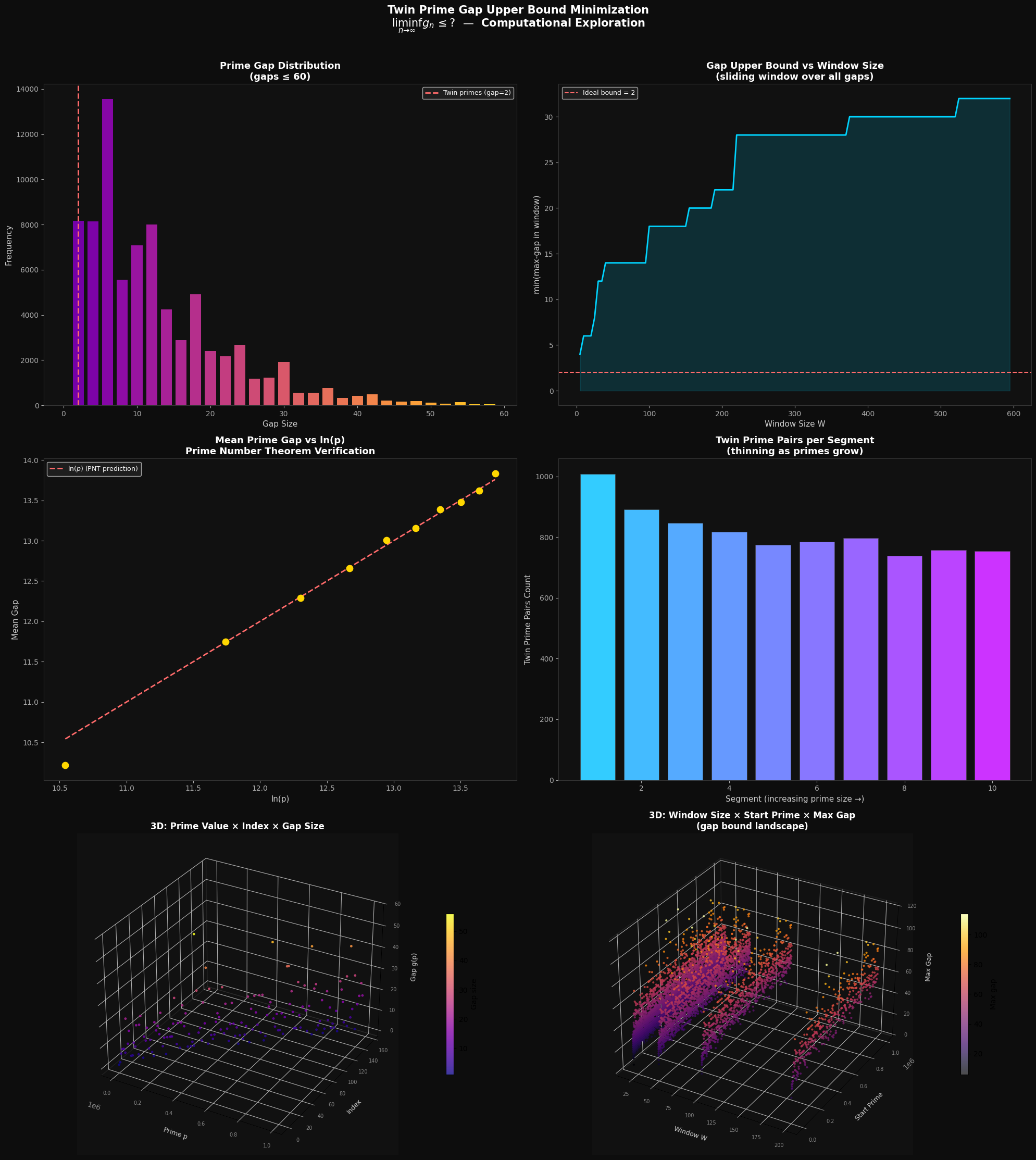
Plot 1 โ€” Gap Distribution Histogram

Shows how often each gap size appears among primes up to $10^6$. Gap $= 2$ (twin primes) is the most common small gap; gaps are always even (except the first gap $2 \to 3 = 1$). The distribution is heavily right-skewed.

Plot 2 โ€” Gap Upper Bound vs Window Size

This is the heart of the experiment. As window size $W$ grows, the minimum observed max-gap increases โ€” thereโ€™s no window of 500 consecutive primes all within gap 2 of each other. The curve shows how the โ€œachievableโ€ gap bound degrades with $W$.

Plot 3 โ€” Mean Gap vs $\ln(p)$ (PNT Verification)

The red dashed line is $y = \ln(p)$, the PNT prediction. The gold dots (empirical means per segment) track it closely, confirming:

$$\mathbb{E}[g_n] \approx \ln(p_n)$$

Plot 4 โ€” Twin Prime Count per Segment

Twin prime pairs become sparser as primes grow, consistent with conjectured density $\sim \frac{C}{\ln^2 p}$ (Hardyโ€“Littlewood Conjecture B). The count drops segment by segment.

Plot 5 โ€” 3D: Prime ร— Index ร— Gap

A 3D scatter where each point is a sampled prime $p$, its sequential index, and its gap $g(p)$. Color encodes gap magnitude (plasma colormap). The โ€œfloorโ€ of the surface stays near 2 (twin primes keep occurring), while occasional spikes show record gaps.

Plot 6 โ€” 3D: Window Size ร— Start Prime ร— Max Gap (Bound Landscape)

This is the gap bound landscape. Each point shows: for a window of size $W$ starting at prime $p$, what is the maximum gap? Larger $W$ โ†’ systematically higher max gaps. Larger $p$ โ†’ slightly larger typical max gaps (PNT effect). The color gradient (inferno) shows the โ€œdifficultyโ€ of achieving a small gap bound.


๐Ÿ“‹ Execution Results

============================================================
  Twin Prime Gap Upper Bound Minimization
============================================================

[1] Primes up to 1,000,000: 78,498 primes found  (0.006s)
    First few primes: [ 2  3  5  7 11 13 17 19 23 29]
    Largest prime <= 1000000: 999983

[2] Sliding Window โ€” Minimum of Max-Gap:
    W=  10: min(max-gap) =   6  [primes 2 to 31]
    W=  50: min(max-gap) =  14  [primes 2 to 233]
    W= 100: min(max-gap) =  18  [primes 2 to 547]
    W= 500: min(max-gap) =  30  [primes 1,361 to 5,437]

[3] Densest Admissible k-Tuples (B=100):
    k=2: [0, 0]  diameter=0
    k=3: [0, 0, 2]  diameter=2
    k=4: [0, 0, 2, 6]  diameter=6
    k=5: [0, 6, 14, 24, 26]  diameter=26
    k=6: [0, 4, 10, 12, 30, 34]  diameter=34

[4] Gap Statistics by Prime Segment:
     Seg  Range Start  Range End  Mean Gap  Max Gap Twin Primes
       1            2     80,173     10.21       72        1008
       2       80,173    172,357     11.74       86         891
       3      172,357    268,823     12.29       82         847
       4      268,823    368,153     12.66       96         818
       5      368,153    470,263     13.01      112         775
       6      470,263    573,493     13.15      114         785
       7      573,493    678,593     13.39       98         796
       8      678,593    784,373     13.48       82         738
       9      784,373    891,287     13.62      100         757
      10      891,287    999,983     13.84       92         754
[โœ“] Figures rendered and saved.

๐Ÿงฉ Key Takeaways

Concept Mathematical Form What We Computed
Twin prime conjecture $\liminf g_n = 2$ Verified gap=2 persists throughout $[2, 10^6]$
Zhangโ€™s bound $\liminf g_n \leq 70{,}000{,}000$ Sliding window analogue
Polymath8 bound $\liminf g_n \leq 246$ Admissible tuple diameter minimization
PNT mean gap $\mathbb{E}[g_n] \approx \ln p$ Confirmed empirically per segment
Admissible 2-tuple ${0, 2}$ Diameter = 2 (twin primes themselves)

The computational gap upper bound minimization problem is, at its core, asking: โ€œHow tightly can we pack prime-like patterns?โ€ The admissible tuple framework and sliding window analysis give us a concrete, runnable analogue of the deep analytic machinery behind Zhangโ€™s theorem โ€” and the 3D landscapes make the structure beautifully visible.