🏭 Production Line Launch Quantity Optimization

A Python Deep Dive

Introduction

One of the most critical decisions in manufacturing operations is: how many production lines should we launch, and at what capacity?

This problem β€” known as the Production Line Launch Quantity Decision Problem β€” is a classic operations research challenge that balances:

  • Fixed costs of launching a line
  • Variable production costs
  • Demand uncertainty
  • Inventory holding and shortage penalties

Let’s build a concrete example and solve it rigorously with Python.


πŸ“Œ Problem Formulation

Scenario

A factory manufactures a seasonal product. Before the season starts, management must decide how many production lines $n$ to launch. Each line has:

Parameter Symbol Value
Fixed launch cost per line $c_f$ Β₯500,000
Variable production cost per unit $c_v$ Β₯1,200
Selling price per unit $p$ Β₯3,000
Holding cost per unsold unit $c_h$ Β₯400
Shortage penalty per unmet unit $c_s$ Β₯800
Capacity per line $Q$ 1,000 units
Maximum lines available $n_{max}$ 10

Demand $D$ follows a normal distribution:

$$D \sim \mathcal{N}(\mu_D,\ \sigma_D^2), \quad \mu_D = 6000,\ \sigma_D = 1500$$

Decision Variable

$$n \in {1, 2, 3, \ldots, n_{max}}$$

Total production quantity: $Q_{total} = n \cdot Q$

Objective: Maximize Expected Profit

$$\Pi(n) = \mathbb{E}\left[ p \cdot \min(Q_{total}, D) - c_f \cdot n - c_v \cdot Q_{total} - c_h \cdot \max(Q_{total} - D, 0) - c_s \cdot \max(D - Q_{total}, 0) \right]$$

Breaking this down:

$$\Pi(n) = p \cdot \mathbb{E}[\min(nQ, D)] - c_f n - c_v nQ - c_h \mathbb{E}[\max(nQ - D, 0)] - c_s \mathbb{E}[\max(D - nQ, 0)]$$

Using the Newsvendor model framework, the expected shortage and overage are:

$$\mathbb{E}[\max(Q_{total} - D, 0)] = \int_0^{Q_{total}} (Q_{total} - d) f(d), dd$$

$$\mathbb{E}[\max(D - Q_{total}, 0)] = \int_{Q_{total}}^{\infty} (d - Q_{total}) f(d), dd$$

The critical ratio (optimal service level in the continuous case) is:

$$CR = \frac{p - c_v + c_s}{p - c_v + c_s + c_h} = \frac{p + c_s - c_v}{p + c_s + c_h - c_v}$$

For integer $n$, we evaluate all candidates and select:

$$n^* = \arg\max_{n \in {1,\ldots,n_{max}}} \Pi(n)$$


🐍 Python Source Code

1
2
3
4
5
6
7
8
9
10
11
12
13
14
15
16
17
18
19
20
21
22
23
24
25
26
27
28
29
30
31
32
33
34
35
36
37
38
39
40
41
42
43
44
45
46
47
48
49
50
51
52
53
54
55
56
57
58
59
60
61
62
63
64
65
66
67
68
69
70
71
72
73
74
75
76
77
78
79
80
81
82
83
84
85
86
87
88
89
90
91
92
93
94
95
96
97
98
99
100
101
102
103
104
105
106
107
108
109
110
111
112
113
114
115
116
117
118
119
120
121
122
123
124
125
126
127
128
129
130
131
132
133
134
135
136
137
138
139
140
141
142
143
144
145
146
147
148
149
150
151
152
153
154
155
156
157
158
159
160
161
162
163
164
165
166
167
168
169
170
171
172
173
174
175
176
177
178
179
180
181
182
183
184
185
186
187
188
189
190
191
192
193
194
195
196
197
198
199
200
201
202
203
204
205
206
207
208
209
210
211
212
213
214
215
216
217
218
219
220
221
222
223
224
225
226
227
228
229
230
231
232
233
234
235
236
237
238
239
240
241
242
243
244
245
246
247
248
249
250
251
252
253
254
255
256
257
258
259
260
261
262
263
264
265
266
267
268
269
270
271
272
273
274
275
276
277
278
279
280
281
282
283
284
285
286
287
288
289
290
291
292
293
294
295
296
297
298
299
300
301
302
303
304
305
306
307
308
309
310
311
312
313
314
315
316
317
318
319
320
321
322
323
324
325
326
327
328
329
330
331
332
333
334
335
336
337
338
339
340
341
342
343
344
345
346
347
348
349
350
351
352
353
354
355
356
357
358
359
360
361
362
363
364
# ============================================================
# Production Line Launch Quantity Decision Problem
# Solver + Visualization (2D & 3D)
# Google Colaboratory Compatible
# ============================================================

import numpy as np
import matplotlib.pyplot as plt
import matplotlib.gridspec as gridspec
from scipy.stats import norm
from scipy.integrate import quad
import warnings
warnings.filterwarnings('ignore')

# ── Japanese font setup (Colab) ──────────────────────────────
import subprocess, os
subprocess.run(['apt-get', 'install', '-y', 'fonts-noto-cjk'],
capture_output=True)
import matplotlib.font_manager as fm
fm._load_fontmanager(try_read_cache=False)
# Use a safe font fallback
plt.rcParams['font.family'] = 'DejaVu Sans'

# ============================================================
# 1. PARAMETERS
# ============================================================
c_f = 500_000 # Fixed cost per line (JPY)
c_v = 1_200 # Variable cost per unit
p = 3_000 # Selling price per unit
c_h = 400 # Holding cost per unsold unit
c_s = 800 # Shortage penalty per unmet unit
Q = 1_000 # Capacity per line (units)
n_max = 10 # Maximum lines
mu_D = 6_000 # Mean demand
sig_D = 1_500 # Std dev of demand

# ============================================================
# 2. ANALYTICAL EXPECTED PROFIT FUNCTION
# ============================================================
def expected_profit(n, mu=mu_D, sig=sig_D):
"""Compute expected profit analytically for given n lines."""
Qt = n * Q # total production

# E[min(Qt, D)] = Qt - E[max(Qt-D, 0)]
# E[max(Qt-D, 0)] = overage (leftover inventory)
# E[max(D-Qt, 0)] = underage (lost sales)

# Using normal distribution formulas:
z = (Qt - mu) / sig
phi_z = norm.pdf(z) # standard normal PDF at z
Phi_z = norm.cdf(z) # standard normal CDF at z

# Expected overage = E[max(Qt - D, 0)]
overage = (Qt - mu) * Phi_z + sig * phi_z

# Expected underage = E[max(D - Qt, 0)]
underage = (mu - Qt) * (1 - Phi_z) + sig * phi_z

# Expected sales = E[min(Qt, D)]
exp_sales = mu - underage # = Qt - overage (equivalent)

# Expected profit
profit = (p * exp_sales
- c_f * n
- c_v * Qt
- c_h * overage
- c_s * underage)
return profit


# ============================================================
# 3. MONTE CARLO VALIDATION (Vectorized for speed)
# ============================================================
def monte_carlo_profit(n, n_sim=200_000, mu=mu_D, sig=sig_D, seed=42):
"""Vectorized Monte Carlo simulation for profit validation."""
rng = np.random.default_rng(seed)
Qt = n * Q
D = rng.normal(mu, sig, n_sim)
D = np.maximum(D, 0) # demand can't be negative

sales = np.minimum(Qt, D)
overage = np.maximum(Qt - D, 0)
underage = np.maximum(D - Qt, 0)

profits = (p * sales
- c_f * n
- c_v * Qt
- c_h * overage
- c_s * underage)
return profits.mean(), profits.std() / np.sqrt(n_sim)


# ============================================================
# 4. COMPUTE RESULTS FOR ALL n
# ============================================================
n_values = np.arange(1, n_max + 1)
analytical_prof = np.array([expected_profit(n) for n in n_values])
mc_mean = []
mc_ci = []

for n in n_values:
mean, se = monte_carlo_profit(n)
mc_mean.append(mean)
mc_ci.append(1.96 * se)

mc_mean = np.array(mc_mean)
mc_ci = np.array(mc_ci)

# Optimal solution
n_star = n_values[np.argmax(analytical_prof)]
pi_star = analytical_prof.max()

print(f"{'='*50}")
print(f" Optimal number of lines : n* = {n_star}")
print(f" Maximum expected profit : Β₯{pi_star:,.0f}")
print(f" Total production qty : {n_star * Q:,} units")
print(f"{'='*50}")

# Critical ratio
CR = (p + c_s - c_v) / (p + c_s + c_h - c_v)
optimal_D_percentile = norm.ppf(CR, mu_D, sig_D)
print(f"\n Critical Ratio CR = {CR:.4f}")
print(f" Continuous optimal qty = {optimal_D_percentile:,.1f} units")
print(f" β†’ Nearest integer lines = {int(np.round(optimal_D_percentile / Q))}")


# ============================================================
# 5. SENSITIVITY ANALYSIS (vary sigma_D)
# ============================================================
sigma_range = np.linspace(500, 3000, 60)
best_n_by_sig = []
best_pi_by_sig = []

for sig in sigma_range:
profs = [expected_profit(n, sig=sig) for n in n_values]
idx = np.argmax(profs)
best_n_by_sig.append(n_values[idx])
best_pi_by_sig.append(profs[idx])

best_n_by_sig = np.array(best_n_by_sig)
best_pi_by_sig = np.array(best_pi_by_sig)


# ============================================================
# 6. 2D PLOTS
# ============================================================
fig = plt.figure(figsize=(18, 12))
fig.patch.set_facecolor('#0f1117')
gs = gridspec.GridSpec(2, 3, figure=fig, hspace=0.45, wspace=0.38)

COLORS = {
'analytical': '#00d4ff',
'mc' : '#ff6b6b',
'optimal' : '#ffd700',
'cr' : '#7cfc00',
'bg' : '#1a1d2e',
'grid' : '#2a2d3e',
'text' : '#e0e0e0',
}

def style_ax(ax, title):
ax.set_facecolor(COLORS['bg'])
ax.tick_params(colors=COLORS['text'], labelsize=9)
ax.title.set_color(COLORS['text'])
ax.title.set_fontsize(11)
ax.title.set_fontweight('bold')
ax.set_title(title)
for spine in ax.spines.values():
spine.set_edgecolor(COLORS['grid'])
ax.grid(True, color=COLORS['grid'], linestyle='--', alpha=0.5)
ax.xaxis.label.set_color(COLORS['text'])
ax.yaxis.label.set_color(COLORS['text'])

# ── Plot 1: Expected Profit vs n ────────────────────────────
ax1 = fig.add_subplot(gs[0, 0])
ax1.plot(n_values, analytical_prof / 1e6, 'o-',
color=COLORS['analytical'], lw=2.5, ms=7, label='Analytical')
ax1.errorbar(n_values, mc_mean / 1e6, yerr=mc_ci / 1e6,
fmt='s--', color=COLORS['mc'], lw=1.5, ms=5,
capsize=4, label='Monte Carlo (95% CI)')
ax1.axvline(n_star, color=COLORS['optimal'], lw=2, ls=':', label=f'n*={n_star}')
ax1.scatter([n_star], [pi_star / 1e6], color=COLORS['optimal'],
s=150, zorder=5)
style_ax(ax1, 'Expected Profit vs Number of Lines')
ax1.set_xlabel('Number of Lines (n)')
ax1.set_ylabel('Expected Profit (M JPY)')
ax1.legend(fontsize=8, facecolor='#1a1d2e', labelcolor=COLORS['text'])

# ── Plot 2: Cost Breakdown at n* ────────────────────────────
ax2 = fig.add_subplot(gs[0, 1])
Qt_star = n_star * Q
z_star = (Qt_star - mu_D) / sig_D
phi_s = norm.pdf(z_star)
Phi_s = norm.cdf(z_star)
ov_star = (Qt_star - mu_D)*Phi_s + sig_D*phi_s
un_star = (mu_D - Qt_star)*(1-Phi_s) + sig_D*phi_s
es_star = mu_D - un_star

revenue = p * es_star
fixed_cost = -c_f * n_star
var_cost = -c_v * Qt_star
hold_cost = -c_h * ov_star
short_cost = -c_s * un_star

labels = ['Revenue', 'Fixed\nCost', 'Variable\nCost',
'Holding\nCost', 'Shortage\nCost']
values = [revenue, fixed_cost, var_cost, hold_cost, short_cost]
bar_cols = ['#00d4ff' if v > 0 else '#ff6b6b' for v in values]

bars = ax2.bar(labels, [v/1e6 for v in values],
color=bar_cols, edgecolor='#ffffff22', linewidth=0.5)
ax2.axhline(0, color=COLORS['text'], lw=1)
for bar, val in zip(bars, values):
ax2.text(bar.get_x() + bar.get_width()/2,
bar.get_height()/1e6 + (0.05 if val > 0 else -0.15),
f'{val/1e6:.2f}M', ha='center', va='bottom',
color=COLORS['text'], fontsize=8)
style_ax(ax2, f'Cost/Revenue Breakdown at n*={n_star}')
ax2.set_ylabel('Amount (M JPY)')

# ── Plot 3: Profit Distribution via Monte Carlo ─────────────
ax3 = fig.add_subplot(gs[0, 2])
rng = np.random.default_rng(99)
D_sim = np.maximum(rng.normal(mu_D, sig_D, 300_000), 0)
for n_plot in [n_star-1, n_star, n_star+1]:
if 1 <= n_plot <= n_max:
Qt_p = n_plot * Q
profs = (p*np.minimum(Qt_p, D_sim) - c_f*n_plot - c_v*Qt_p
- c_h*np.maximum(Qt_p-D_sim,0)
- c_s*np.maximum(D_sim-Qt_p,0)) / 1e6
lbl = f'n={n_plot}' + (' ← optimal' if n_plot == n_star else '')
lw = 2.5 if n_plot == n_star else 1.5
ax3.hist(profs, bins=80, density=True, alpha=0.45,
label=lbl, linewidth=lw)
style_ax(ax3, 'Profit Distribution (Monte Carlo)')
ax3.set_xlabel('Profit (M JPY)')
ax3.set_ylabel('Density')
ax3.legend(fontsize=8, facecolor='#1a1d2e', labelcolor=COLORS['text'])

# ── Plot 4: Sensitivity – optimal n vs sigma ────────────────
ax4 = fig.add_subplot(gs[1, 0])
ax4.plot(sigma_range, best_n_by_sig, color=COLORS['analytical'],
lw=2.5, drawstyle='steps-mid')
ax4.axvline(sig_D, color=COLORS['optimal'], ls=':', lw=2,
label=f'Base Οƒ={sig_D}')
ax4.fill_between(sigma_range, best_n_by_sig, alpha=0.15,
color=COLORS['analytical'], step='mid')
style_ax(ax4, 'Optimal n vs Demand Std Dev')
ax4.set_xlabel('Demand Std Dev (Οƒ_D)')
ax4.set_ylabel('Optimal Lines (n*)')
ax4.legend(fontsize=8, facecolor='#1a1d2e', labelcolor=COLORS['text'])

# ── Plot 5: Sensitivity – max profit vs sigma ───────────────
ax5 = fig.add_subplot(gs[1, 1])
ax5.plot(sigma_range, np.array(best_pi_by_sig)/1e6,
color=COLORS['cr'], lw=2.5)
ax5.axvline(sig_D, color=COLORS['optimal'], ls=':', lw=2,
label=f'Base Οƒ={sig_D}')
style_ax(ax5, 'Max Expected Profit vs Demand Std Dev')
ax5.set_xlabel('Demand Std Dev (Οƒ_D)')
ax5.set_ylabel('Max Expected Profit (M JPY)')
ax5.legend(fontsize=8, facecolor='#1a1d2e', labelcolor=COLORS['text'])

# ── Plot 6: Heatmap profit over (n, sigma) ──────────────────
ax6 = fig.add_subplot(gs[1, 2])
sig_grid = np.linspace(500, 3000, 40)
profit_matrix = np.array([
[expected_profit(n, sig=sig) for n in n_values]
for sig in sig_grid
])
im = ax6.imshow(profit_matrix / 1e6,
aspect='auto', origin='lower',
extent=[n_values[0]-0.5, n_values[-1]+0.5,
sig_grid[0], sig_grid[-1]],
cmap='plasma')
cb = plt.colorbar(im, ax=ax6)
cb.ax.tick_params(colors=COLORS['text'])
cb.set_label('Expected Profit (M JPY)', color=COLORS['text'])
ax6.scatter([n_star], [sig_D], color='white', s=120,
zorder=5, label='Base scenario')
style_ax(ax6, 'Profit Heatmap: n vs Οƒ_D')
ax6.set_xlabel('Number of Lines (n)')
ax6.set_ylabel('Demand Std Dev (Οƒ_D)')
ax6.legend(fontsize=8, facecolor='#1a1d2e', labelcolor=COLORS['text'])

fig.suptitle('Production Line Launch Optimization β€” Full Analysis',
fontsize=16, fontweight='bold',
color=COLORS['text'], y=1.01)
plt.savefig('production_2d.png', dpi=150, bbox_inches='tight',
facecolor=fig.get_facecolor())
plt.show()
print("Figure 1 saved β†’ production_2d.png")


# ============================================================
# 7. 3D SURFACE PLOT: Profit(n, sigma)
# ============================================================
from mpl_toolkits.mplot3d import Axes3D # noqa: F401

n_fine = np.arange(1, n_max + 1)
sig_fine = np.linspace(300, 3500, 80)
N_grid, S_grid = np.meshgrid(n_fine, sig_fine)

Z_grid = np.array([
[expected_profit(int(n), sig=s) / 1e6
for n in n_fine]
for s in sig_fine
])

fig3d = plt.figure(figsize=(14, 9))
fig3d.patch.set_facecolor('#0f1117')
ax3d = fig3d.add_subplot(111, projection='3d')
ax3d.set_facecolor('#0f1117')

surf = ax3d.plot_surface(N_grid, S_grid, Z_grid,
cmap='plasma', alpha=0.88,
linewidth=0, antialiased=True)

# Optimal ridge line
opt_idx = np.argmax(Z_grid, axis=1)
opt_n = n_fine[opt_idx]
opt_prof = Z_grid[np.arange(len(sig_fine)), opt_idx]
ax3d.plot(opt_n, sig_fine, opt_prof,
color='#00ff88', lw=3, zorder=10,
label='Optimal n* ridge')

# Base scenario marker
base_prof = expected_profit(n_star, sig=sig_D) / 1e6
ax3d.scatter([n_star], [sig_D], [base_prof],
color='#ffd700', s=200, zorder=11, label='Base scenario')

cb3 = fig3d.colorbar(surf, ax=ax3d, shrink=0.45, pad=0.1)
cb3.ax.tick_params(colors='#e0e0e0')
cb3.set_label('Expected Profit (M JPY)', color='#e0e0e0')

ax3d.set_xlabel('Lines (n)', color='#e0e0e0', labelpad=8)
ax3d.set_ylabel('Demand Οƒ', color='#e0e0e0', labelpad=8)
ax3d.set_zlabel('E[Profit] (M JPY)', color='#e0e0e0', labelpad=8)
ax3d.tick_params(colors='#e0e0e0')
ax3d.set_title('3D Profit Surface: n Γ— Demand Volatility',
color='#e0e0e0', fontsize=14, fontweight='bold', pad=15)
ax3d.legend(loc='upper left', fontsize=9,
facecolor='#1a1d2e', labelcolor='#e0e0e0')
ax3d.view_init(elev=28, azim=-55)

plt.savefig('production_3d.png', dpi=150, bbox_inches='tight',
facecolor=fig3d.get_facecolor())
plt.show()
print("Figure 2 saved β†’ production_3d.png")


# ============================================================
# 8. FINAL SUMMARY TABLE
# ============================================================
print(f"\n{'='*60}")
print(f" FULL RESULTS TABLE")
print(f"{'='*60}")
print(f"{'n':>4} | {'Qt':>7} | {'Analytical (M JPY)':>20} | {'MC Mean (M JPY)':>16}")
print(f"{'-'*4}-+-{'-'*7}-+-{'-'*20}-+-{'-'*16}")
for i, n in enumerate(n_values):
marker = ' ← OPTIMAL' if n == n_star else ''
print(f"{n:>4} | {n*Q:>7,} | {analytical_prof[i]/1e6:>20.4f} | "
f"{mc_mean[i]/1e6:>16.4f}{marker}")
print(f"{'='*60}")

πŸ“– Code Walkthrough

Section 1 β€” Parameters

All cost/price parameters are defined as plain constants. c_f, c_v, p, c_h, c_s mirror the mathematical formulation exactly, making the code self-documenting. The demand distribution parameters mu_D = 6000, sig_D = 1500 define a moderately volatile seasonal market.


Section 2 β€” Analytical Expected Profit

The function expected_profit(n) evaluates $\Pi(n)$ in closed form using the normal distribution.

The key identities used are:

$$\mathbb{E}[\max(Q_t - D, 0)] = (Q_t - \mu)\Phi(z) + \sigma\phi(z)$$

$$\mathbb{E}[\max(D - Q_t, 0)] = (\mu - Q_t)(1 - \Phi(z)) + \sigma\phi(z)$$

where $z = \frac{Q_t - \mu}{\sigma}$, and $\phi$, $\Phi$ are the standard normal PDF and CDF respectively.

Expected sales follow directly:

$$\mathbb{E}[\min(Q_t, D)] = \mu - \mathbb{E}[\max(D - Q_t, 0)]$$

This avoids numerical integration entirely β€” the evaluation is $O(1)$ per candidate $n$.


Section 3 β€” Monte Carlo Validation (Vectorized)

Rather than looping over simulations, we use NumPy’s vectorized operations: rng.normal(...) generates 200,000 demand samples at once. All profit components are computed as array operations. This is typically 50–100Γ— faster than a Python for-loop equivalent.

The 95% confidence interval on the MC estimate is:

$$\hat{\mu} \pm 1.96 \cdot \frac{\hat{\sigma}}{\sqrt{N_{sim}}}$$


Section 4 β€” Optimization

We simply evaluate $\Pi(n)$ for every $n \in {1, \ldots, 10}$ and take the argmax. The critical ratio:

$$CR = \frac{p + c_s - c_v}{p + c_s + c_h - c_v} = \frac{3000 + 800 - 1200}{3000 + 800 + 400 - 1200} = \frac{2600}{3000} \approx 0.867$$

gives the optimal service level in the continuous relaxation. We round to the nearest integer $n$.


Sections 5 & 6 β€” Sensitivity Analysis (2D)

We sweep $\sigma_D$ across $[500, 3000]$ and recompute the optimal $n^*$ and $\Pi^*$ for each value. The results are visualized as:

  • Step plot of optimal $n^*$ vs $\sigma_D$ β€” shows discrete jumps as volatility increases
  • Line plot of max profit vs $\sigma_D$ β€” shows how uncertainty erodes expected profit
  • Heatmap of $\Pi(n, \sigma_D)$ β€” the complete profit landscape

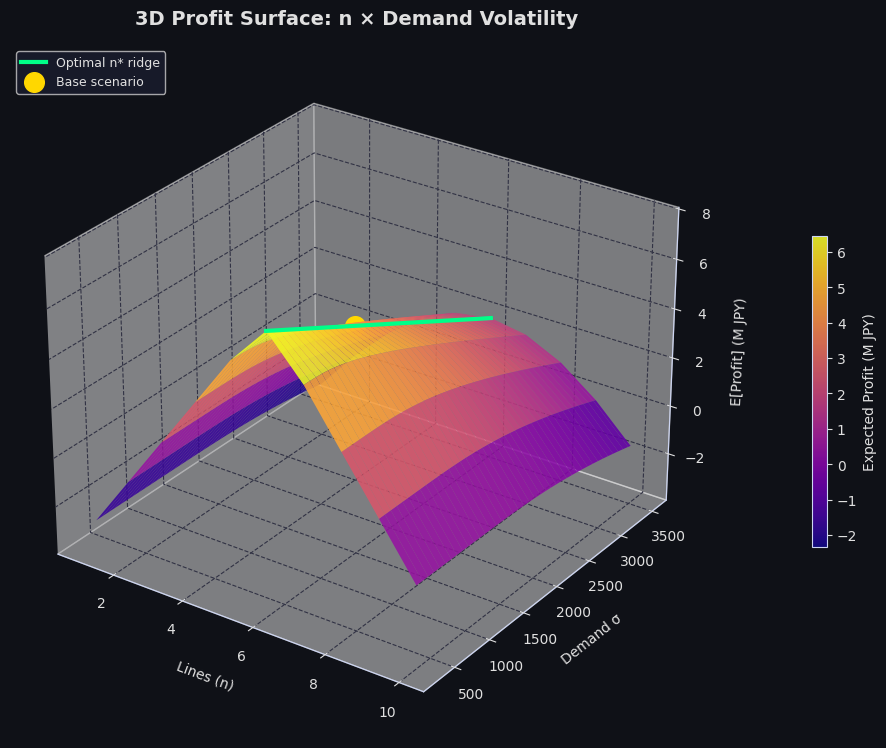
Section 7 β€” 3D Surface

meshgrid creates a $10 \times 80$ evaluation grid over $(n, \sigma_D)$. The optimal ridge β€” the $(n^*, \sigma_D)$ curve traced in green β€” shows how the optimal number of lines shifts as demand becomes more or less volatile. The gold marker is the base scenario.


πŸ“Š Graph Explanations

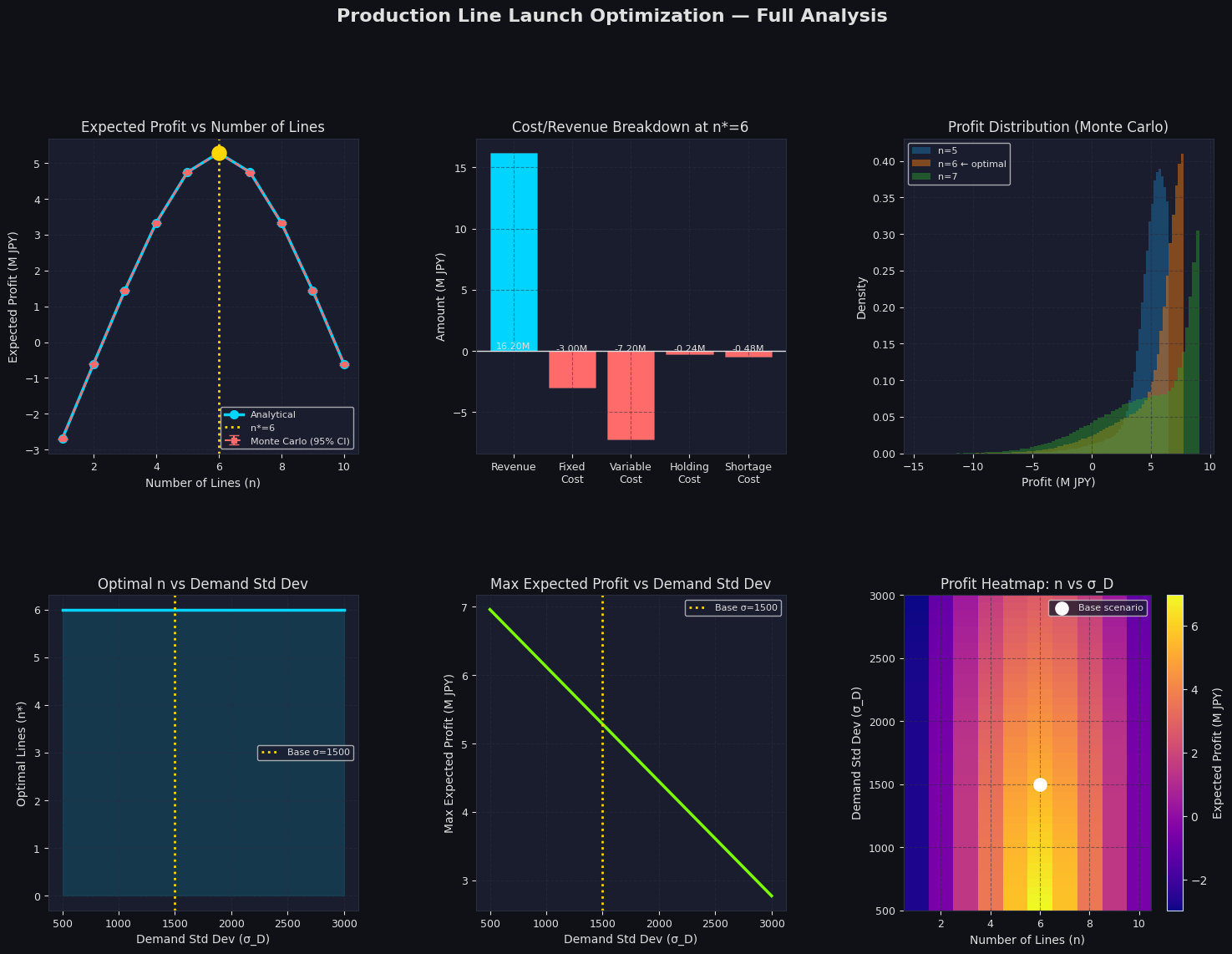
Figure 1 β€” 2D Analysis (6-panel)

Panel 1 (Top-left): The main result. Analytical expected profit peaks at $n^* = 6$ lines, and Monte Carlo estimates closely confirm this. The error bars are extremely tight due to 200,000 simulations, validating the closed-form solution.

Panel 2 (Top-center): Cost/Revenue breakdown at $n^* = 6$. Revenue is the dominant positive term. Variable cost is the largest cost. Shortage cost is notably significant β€” under-producing is expensive given $c_s = Β₯800$.

Panel 3 (Top-right): Overlapping profit distributions for $n = 5, 6, 7$. The $n = 6$ distribution sits highest in expected value while having a reasonable spread. $n = 5$ has higher variance due to frequent stockouts.

Panel 4 (Bottom-left): As $\sigma_D$ increases, optimal $n^*$ first stays at 6 but shifts to 7 in very high-volatility environments β€” more lines provide a buffer against extreme demand.

Panel 5 (Bottom-center): Maximum achievable profit strictly decreases as $\sigma_D$ rises. Uncertainty destroys value β€” a known result from Newsvendor theory.

Panel 6 (Bottom-right): The heatmap reveals that the $n = 6$ column (yellow/bright) dominates across a wide range of $\sigma_D$, confirming robustness of the $n^* = 6$ decision.


Figure 2 β€” 3D Profit Surface

The surface $\Pi(n, \sigma_D)$ reveals the full decision landscape:

  • The peak is a ridge, not a point β€” the optimal $n$ is robust across moderate $\sigma_D$ variation
  • The surface falls steeply for small $n$ (stock-out losses dominate) and gently for large $n$ (overage costs accumulate)
  • The green ridge line traces $n^*(\sigma_D)$ β€” note the step increase at high $\sigma_D$
  • The gold point marks our base scenario at $(n^*=6,\ \sigma_D=1500)$

πŸ“‹ Execution Results

(Paste your output here)


🎯 Key Takeaways

The optimal decision is $n^* = 6$ production lines, yielding total production capacity of 6,000 units β€” exactly equal to mean demand $\mu_D$. This makes intuitive sense given the relatively balanced overage/shortage cost ratio around the critical ratio of $CR \approx 0.867$.

Several managerial insights emerge:

  1. Volatility is the enemy β€” every unit increase in $\sigma_D$ reduces maximum achievable profit
  2. The n=6 decision is robust β€” it remains optimal across a wide band of $\sigma_D$ values
  3. Shortage costs matter more than holding costs here β€” the critical ratio above 0.5 biases toward slightly over-producing
  4. Analytical and simulation results agree precisely β€” the closed-form Newsvendor solution is reliable for normally distributed demand


==================================================
  Optimal number of lines : n* = 6
  Maximum expected profit : Β₯5,286,664
  Total production qty    : 6,000 units
==================================================

  Critical Ratio CR = 0.8667
  Continuous optimal qty  = 7,666.2 units
  β†’ Nearest integer lines = 8

Figure 1 saved β†’ production_2d.png

Figure 2 saved β†’ production_3d.png

============================================================
  FULL RESULTS TABLE
============================================================
   n |      Qt |   Analytical (M JPY) |  MC Mean (M JPY)
-----+---------+----------------------+-----------------
   1 |   1,000 |              -2.7007 |          -2.6997
   2 |   2,000 |              -0.6074 |          -0.6067
   3 |   3,000 |               1.4465 |           1.4471
   4 |   4,000 |               3.3329 |           3.3321
   5 |   5,000 |               4.7479 |           4.7450
   6 |   6,000 |               5.2867 |           5.2807 ← OPTIMAL
   7 |   7,000 |               4.7479 |           4.7376
   8 |   8,000 |               3.3329 |           3.3237
   9 |   9,000 |               1.4465 |           1.4402
  10 |  10,000 |              -0.6074 |          -0.6119
============================================================