Optimizing Heat Conduction Paths

Minimizing Thermal Resistance Through Structural Design

Heat transfer engineering is a critical discipline in electronics cooling, aerospace, and materials science. In this post, we’ll tackle a classic structural optimization problem: how should we distribute high-conductivity material within a domain to maximize heat flow (minimize thermal resistance)?


Problem Formulation

We consider a 2D square domain $\Omega$ with a heat source and a heat sink. The goal is to find the optimal distribution of two materials — a high-conductivity material ($k_1$) and a low-conductivity base material ($k_0$) — subject to a volume constraint on the high-conductivity material.

Governing Equation

The steady-state heat conduction equation:

$$-\nabla \cdot (k(\mathbf{x}) \nabla T) = Q \quad \text{in } \Omega$$

with boundary conditions:

$$T = T_{\text{sink}} \quad \text{on } \Gamma_D, \qquad -k \frac{\partial T}{\partial n} = 0 \quad \text{on } \Gamma_N$$

Thermal Compliance (Objective to Minimize)

The thermal compliance (analogous to structural compliance) is:

$$C = \int_\Omega Q \cdot T , d\Omega$$

Minimizing $C$ is equivalent to minimizing thermal resistance, or maximizing heat flow from source to sink.

SIMP Interpolation

Using the Solid Isotropic Material with Penalization (SIMP) scheme:

$$k(\rho) = k_0 + \rho^p (k_1 - k_0)$$

where $\rho \in [0, 1]$ is the design variable (material density) and $p$ is the penalization exponent (typically $p = 3$).

Sensitivity Analysis

The sensitivity of the objective with respect to $\rho_e$:

$$\frac{\partial C}{\partial \rho_e} = -p \rho_e^{p-1}(k_1 - k_0) \int_{\Omega_e} |\nabla T|^2 , d\Omega_e$$

Optimality Criteria Update

$$\rho_e^{\text{new}} = \rho_e \cdot \left( \frac{-\partial C / \partial \rho_e}{\lambda} \right)^{1/2}$$

clipped to $[\rho_{\min}, 1]$, where $\lambda$ is found by bisection to satisfy the volume constraint.


Python Implementation

1
2
3
4
5
6
7
8
9
10
11
12
13
14
15
16
17
18
19
20
21
22
23
24
25
26
27
28
29
30
31
32
33
34
35
36
37
38
39
40
41
42
43
44
45
46
47
48
49
50
51
52
53
54
55
56
57
58
59
60
61
62
63
64
65
66
67
68
69
70
71
72
73
74
75
76
77
78
79
80
81
82
83
84
85
86
87
88
89
90
91
92
93
94
95
96
97
98
99
100
101
102
103
104
105
106
107
108
109
110
111
112
113
114
115
116
117
118
119
120
121
122
123
124
125
126
127
128
129
130
131
132
133
134
135
136
137
138
139
140
141
142
143
144
145
146
147
148
149
150
151
152
153
154
155
156
157
158
159
160
161
162
163
164
165
166
167
168
169
170
171
172
173
174
175
176
177
178
179
180
181
182
183
184
185
186
187
188
189
190
191
192
193
194
195
196
197
198
199
200
201
202
203
204
205
206
207
208
209
210
211
212
213
214
215
216
217
218
219
220
221
222
223
224
225
226
227
228
229
230
231
232
233
234
235
236
237
238
239
240
241
242
243
244
245
246
247
248
249
250
251
252
253
254
255
256
257
258
259
260
261
262
263
264
265
266
267
268
269
270
271
272
273
274
275
276
277
278
279
280
281
282
283
284
285
286
287
288
289
290
291
292
293
294
295
296
297
298
299
300
301
302
303
304
305
306
307
308
309
310
311
312
313
314
315
316
317
318
319
320
321
322
323
324
325
326
327
328
329
330
331
332
333
334
335
336
337
338
339
340
341
342
343
344
345
346
347
348
349
350
351
352
353
354
355
356
import numpy as np
import matplotlib.pyplot as plt
from matplotlib import cm
from mpl_toolkits.mplot3d import Axes3D
from scipy.sparse import lil_matrix, csr_matrix
from scipy.sparse.linalg import spsolve
import warnings
warnings.filterwarnings('ignore')

# ============================================================
# Parameters
# ============================================================
nelx, nely = 40, 40 # number of elements in x and y
volfrac = 0.4 # volume fraction of high-k material
penal = 3.0 # SIMP penalization exponent
rmin = 1.5 # filter radius (elements)
k0 = 1.0 # base thermal conductivity
k1 = 100.0 # high-conductivity material
max_iter = 100 # maximum OC iterations
tol = 1e-3 # convergence tolerance

nn = (nelx+1)*(nely+1) # total nodes
ne = nelx*nely # total elements

# ============================================================
# FEM: Element stiffness matrix for bilinear quad element
# ============================================================
def element_stiffness():
"""
Returns 4x4 element conductance matrix for unit square element.
Derived analytically for bilinear shape functions.
"""
ke = np.array([
[ 2/3, -1/6, -1/3, -1/6],
[-1/6, 2/3, -1/6, -1/3],
[-1/3, -1/6, 2/3, -1/6],
[-1/6, -1/3, -1/6, 2/3]
])
return ke

KE = element_stiffness()

# ============================================================
# Node numbering: node (i,j) -> index i*(nely+1)+j
# ============================================================
def node_id(ix, iy):
return ix * (nely + 1) + iy

# ============================================================
# Build DOF map for each element
# ============================================================
edof = np.zeros((ne, 4), dtype=int)
for ix in range(nelx):
for iy in range(nely):
e = ix * nely + iy
edof[e, 0] = node_id(ix, iy)
edof[e, 1] = node_id(ix, iy+1)
edof[e, 2] = node_id(ix+1, iy)
edof[e, 3] = node_id(ix+1, iy+1)

# ============================================================
# Density filter (weight matrix)
# ============================================================
def build_filter(nelx, nely, rmin):
ne = nelx * nely
H = lil_matrix((ne, ne))
for ix in range(nelx):
for iy in range(nely):
e1 = ix * nely + iy
imin = max(ix - int(np.ceil(rmin)), 0)
imax = min(ix + int(np.ceil(rmin)), nelx-1)
jmin = max(iy - int(np.ceil(rmin)), 0)
jmax = min(iy + int(np.ceil(rmin)), nely-1)
for i2 in range(imin, imax+1):
for j2 in range(jmin, jmax+1):
e2 = i2 * nely + j2
dist = np.sqrt((ix-i2)**2 + (iy-j2)**2)
if dist < rmin:
H[e1, e2] = rmin - dist
Hs = np.array(H.sum(axis=1)).flatten()
return csr_matrix(H), Hs

print("Building filter matrix...")
H, Hs = build_filter(nelx, nely, rmin)

# ============================================================
# Boundary conditions
# ============================================================
# Heat source: all elements in left column -> uniform heat generation Q=1
# Heat sink (Dirichlet T=0): right edge nodes

# Source vector (nodal heat loads)
f = np.zeros(nn)
# Distribute heat source on left boundary nodes
for iy in range(nely+1):
nid = node_id(0, iy)
f[nid] += 1.0 / (nely) # total load = 1

# Fixed temperature nodes (right edge, T=0)
fixed_nodes = np.array([node_id(nelx, iy) for iy in range(nely+1)])
free_nodes = np.setdiff1d(np.arange(nn), fixed_nodes)

# ============================================================
# FEM solver
# ============================================================
def solve_fem(rho_phys):
"""Assemble global K and solve KT=f."""
K = lil_matrix((nn, nn))
ke_coeff = k0 + rho_phys**penal * (k1 - k0)
for e in range(ne):
ke_val = ke_coeff[e]
dofs = edof[e]
for i in range(4):
for j in range(4):
K[dofs[i], dofs[j]] += ke_val * KE[i, j]
K = csr_matrix(K)
# Apply Dirichlet BC
T = np.zeros(nn)
Kff = K[free_nodes, :][:, free_nodes]
ff = f[free_nodes]
T[free_nodes] = spsolve(Kff, ff)
return T

# ============================================================
# Sensitivity analysis
# ============================================================
def compute_sensitivity(T, rho_phys):
"""Compute dC/d(rho) for each element."""
dc = np.zeros(ne)
for e in range(ne):
dofs = edof[e]
Te = T[dofs]
dc[e] = -penal * rho_phys[e]**(penal-1) * (k1-k0) * (Te @ KE @ Te)
return dc

# ============================================================
# Optimality Criteria update
# ============================================================
def oc_update(rho, dc, dv, volfrac):
"""Bisection to find Lagrange multiplier lambda."""
l1, l2 = 1e-9, 1e9
move = 0.2
rho_new = rho.copy()
while (l2 - l1) / (l1 + l2) > 1e-6:
lmid = 0.5 * (l1 + l2)
B = np.sqrt(-dc / (lmid * dv))
rho_new = np.clip(rho * B, 1e-3, 1.0)
rho_new = np.clip(rho_new, rho - move, rho + move)
if rho_new.sum() - volfrac * ne > 0:
l1 = lmid
else:
l2 = lmid
return rho_new

# ============================================================
# Main optimization loop
# ============================================================
rho = np.full(ne, volfrac) # initial density
history_C = []
history_vol = []
rho_history = []

print("Starting topology optimization...")
for it in range(max_iter):
# Filter density
rho_phys = np.array(H @ rho) / Hs

# FEM solve
T = solve_fem(rho_phys)

# Thermal compliance (objective)
C = float(f @ T)

# Sensitivity
dc = compute_sensitivity(T, rho_phys)

# Filter sensitivity
dc_filtered = np.array(H @ (rho * dc)) / (Hs * np.maximum(rho, 1e-3))

dv = np.ones(ne) # volume sensitivity = 1

# OC update
rho_new = oc_update(rho, dc_filtered, dv, volfrac)

# Check convergence
change = np.max(np.abs(rho_new - rho))
rho = rho_new

history_C.append(C)
history_vol.append(rho_phys.sum() / ne)

if it % 10 == 0 or change < tol:
print(f"Iter {it+1:3d} | Compliance C = {C:.4f} | "
f"Vol = {rho_phys.sum()/ne:.3f} | Change = {change:.4f}")

if it % 20 == 0:
rho_history.append((it, rho_phys.copy()))

if change < tol and it > 10:
print(f"\nConverged at iteration {it+1}")
break

rho_final = np.array(H @ rho) / Hs

# ============================================================
# Visualization
# ============================================================
fig = plt.figure(figsize=(20, 16))

# --- 1. Optimal density distribution (2D) ---
ax1 = fig.add_subplot(2, 3, 1)
rho_2d = rho_final.reshape(nelx, nely).T
im = ax1.imshow(rho_2d, cmap='Blues', origin='lower',
vmin=0, vmax=1, aspect='equal')
plt.colorbar(im, ax=ax1, label='Density ρ')
ax1.set_title('Optimal Material Distribution\n(Blue = High-k material)', fontsize=11)
ax1.set_xlabel('x (elements)')
ax1.set_ylabel('y (elements)')

# --- 2. Temperature field (2D) ---
ax2 = fig.add_subplot(2, 3, 2)
T_2d = T.reshape(nelx+1, nely+1).T
cont = ax2.contourf(T_2d, levels=30, cmap='hot_r')
plt.colorbar(cont, ax=ax2, label='Temperature T')
ax2.set_title('Temperature Distribution\n(Final optimized structure)', fontsize=11)
ax2.set_xlabel('x (nodes)')
ax2.set_ylabel('y (nodes)')

# --- 3. Convergence history ---
ax3 = fig.add_subplot(2, 3, 3)
ax3.plot(history_C, 'b-o', markersize=3, label='Compliance C')
ax3.set_xlabel('Iteration')
ax3.set_ylabel('Thermal Compliance C', color='b')
ax3.tick_params(axis='y', labelcolor='b')
ax3_twin = ax3.twinx()
ax3_twin.plot(history_vol, 'r--s', markersize=3, label='Volume fraction')
ax3_twin.set_ylabel('Volume Fraction', color='r')
ax3_twin.tick_params(axis='y', labelcolor='r')
ax3_twin.axhline(volfrac, color='r', linestyle=':', alpha=0.5)
ax3.set_title('Convergence History', fontsize=11)
ax3.grid(True, alpha=0.3)

# --- 4. 3D density surface ---
ax4 = fig.add_subplot(2, 3, 4, projection='3d')
X = np.arange(nelx)
Y = np.arange(nely)
Xg, Yg = np.meshgrid(X, Y)
surf = ax4.plot_surface(Xg, Yg, rho_2d.T, cmap='Blues',
edgecolor='none', alpha=0.9)
ax4.set_xlabel('X element')
ax4.set_ylabel('Y element')
ax4.set_zlabel('Density ρ')
ax4.set_title('3D Optimal Density\nSurface Plot', fontsize=11)
plt.colorbar(surf, ax=ax4, shrink=0.5, label='ρ')

# --- 5. 3D Temperature surface ---
ax5 = fig.add_subplot(2, 3, 5, projection='3d')
Xn = np.arange(nelx+1)
Yn = np.arange(nely+1)
Xng, Yng = np.meshgrid(Xn, Yn)
surf2 = ax5.plot_surface(Xng, Yng, T_2d, cmap='hot_r',
edgecolor='none', alpha=0.9)
ax5.set_xlabel('X node')
ax5.set_ylabel('Y node')
ax5.set_zlabel('Temperature T')
ax5.set_title('3D Temperature\nDistribution', fontsize=11)
plt.colorbar(surf2, ax=ax5, shrink=0.5, label='T')

# --- 6. Optimization snapshots ---
ax6 = fig.add_subplot(2, 3, 6)
n_snap = len(rho_history)
cols = min(n_snap, 5)
snap_arr = np.zeros((nely, nelx * cols + (cols - 1)))
for idx, (it_num, rho_snap) in enumerate(rho_history[:cols]):
rho_snap_2d = rho_snap.reshape(nelx, nely).T
start = idx * (nelx + 1)
snap_arr[:, start:start+nelx] = rho_snap_2d
if idx < cols - 1:
snap_arr[:, start+nelx] = 0.5
ax6.imshow(snap_arr, cmap='Blues', origin='lower', vmin=0, vmax=1, aspect='auto')
ax6.set_title(f'Density Evolution\n(every 20 iterations)', fontsize=11)
ax6.set_xlabel('Iteration snapshots →')
ax6.set_yticks([])
labels = [f"It.{rho_history[i][0]}" for i in range(min(cols, n_snap))]
tick_pos = [i * (nelx + 1) + nelx // 2 for i in range(cols)]
ax6.set_xticks(tick_pos)
ax6.set_xticklabels(labels, fontsize=8)

plt.suptitle('Thermal Conduction Path Optimization (SIMP Method)\n'
f'Grid: {nelx}×{nely}, k₀={k0}, k₁={k1}, '
f'Vol. fraction={volfrac}, Penalty p={penal}',
fontsize=13, y=1.01)
plt.tight_layout()
plt.savefig('thermal_optimization.png', dpi=150, bbox_inches='tight')
plt.show()

# ============================================================
# Heat flux vector field
# ============================================================
fig2, axes2 = plt.subplots(1, 2, figsize=(14, 6))

# Compute element-averaged heat flux
qx = np.zeros(ne)
qy = np.zeros(ne)
for e in range(ne):
ix = e // nely
iy = e % nely
dofs = edof[e]
Te = T[dofs]
k_e = k0 + rho_final[e]**penal * (k1 - k0)
# dN/dx, dN/dy for bilinear element (unit square, center)
dNdx = 0.25 * np.array([-1, -1, 1, 1])
dNdy = 0.25 * np.array([-1, 1, -1, 1])
qx[e] = -k_e * (dNdx @ Te)
qy[e] = -k_e * (dNdy @ Te)

qx_2d = qx.reshape(nelx, nely).T
qy_2d = qy.reshape(nelx, nely).T
qmag = np.sqrt(qx_2d**2 + qy_2d**2)

# Left: heat flux magnitude with streamlines
ax_l = axes2[0]
cf = ax_l.contourf(qmag, levels=30, cmap='YlOrRd', origin='lower')
plt.colorbar(cf, ax=ax_l, label='|q| Heat Flux Magnitude')
skip = 3
Xe = np.arange(nelx)
Ye = np.arange(nely)
Xeg, Yeg = np.meshgrid(Xe, Ye)
ax_l.quiver(Xeg[::skip, ::skip], Yeg[::skip, ::skip],
qx_2d[::skip, ::skip], qy_2d[::skip, ::skip],
color='black', alpha=0.6, scale=None, width=0.003)
ax_l.set_title('Heat Flux Field\n(arrows = direction, color = magnitude)', fontsize=11)
ax_l.set_xlabel('x (elements)')
ax_l.set_ylabel('y (elements)')

# Right: overlay of density + heat flux
ax_r = axes2[1]
ax_r.imshow(rho_2d.T, cmap='Blues', origin='lower', vmin=0, vmax=1,
aspect='equal', alpha=0.7)
ax_r.quiver(Xeg[::skip, ::skip], Yeg[::skip, ::skip],
qx_2d[::skip, ::skip], qy_2d[::skip, ::skip],
color='red', alpha=0.8, scale=None, width=0.003)
ax_r.set_title('Optimal Material + Heat Flux Overlay\n(Blue=material, Red arrows=heat flow)', fontsize=11)
ax_r.set_xlabel('x (elements)')
ax_r.set_ylabel('y (elements)')

plt.suptitle('Heat Flux Analysis of Optimized Thermal Structure', fontsize=13)
plt.tight_layout()
plt.savefig('heat_flux.png', dpi=150, bbox_inches='tight')
plt.show()

print("\nFinal Results:")
print(f" Final Compliance : {history_C[-1]:.4f}")
print(f" Initial Compliance: {history_C[0]:.4f}")
print(f" Reduction : {(1 - history_C[-1]/history_C[0])*100:.1f}%")
print(f" Final Volume Frac : {rho_final.mean():.4f}")

Code Breakdown

1. SIMP Material Interpolation

The core of topology optimization is the SIMP scheme. Each element gets a density $\rho_e \in [0,1]$, and its conductivity is:

$$k_e = k_0 + \rho_e^p (k_1 - k_0)$$

With $p=3$, intermediate densities are heavily penalized, pushing the solution toward a crisp 0-or-1 design.

1
ke_coeff = k0 + rho_phys**penal * (k1 - k0)

The ratio $k_1/k_0 = 100$ means high-conductivity “channels” carry 100× more heat than the base material.


2. FEM Assembly — Bilinear Quad Element

The element conductance matrix for a unit square bilinear element is derived analytically:

$$[K_e] = k_e \int_{\Omega_e} [\nabla N]^T [\nabla N] , d\Omega$$

The result is the $4\times4$ matrix KE assembled once and reused for all elements (scaled by $k_e$). Global assembly loops over all elements and scatters contributions into the global sparse matrix:

1
K[dofs[i], dofs[j]] += ke_val * KE[i, j]

Dirichlet BCs (right edge fixed at $T=0$) are applied by extracting the free-DOF submatrix and solving:

$$[K_{ff}]{T_f} = {f_f}$$


3. Sensitivity Filtering

Raw sensitivities are noisy at the element level. A density filter smooths them:

$$\tilde{\partial C / \partial \rho_e} = \frac{1}{H_e \hat{\rho}e} \sum{f \in N_e} H_{ef} \hat{\rho}_f \frac{\partial C}{\partial \hat{\rho}_f}$$

where $H_{ef} = \max(0, r_{\min} - |e - f|)$ is the filter weight. This prevents checkerboard instabilities and mesh-dependent results.


4. Optimality Criteria (OC) Update

Instead of gradient descent, we use the Optimality Criteria method, which exploits the KKT conditions:

$$\rho_e^{\text{new}} = \min\left(1,, \min\left(\rho_e + m,, \max\left(\rho_{\min},, \max\left(\rho_e - m,, \rho_e \sqrt{\frac{-\partial C/\partial \rho_e}{\lambda}}\right)\right)\right)\right)$$

The Lagrange multiplier $\lambda$ is found by bisection to enforce the volume constraint $\sum \rho_e = V_f \cdot N_e$.


Graphs and Results
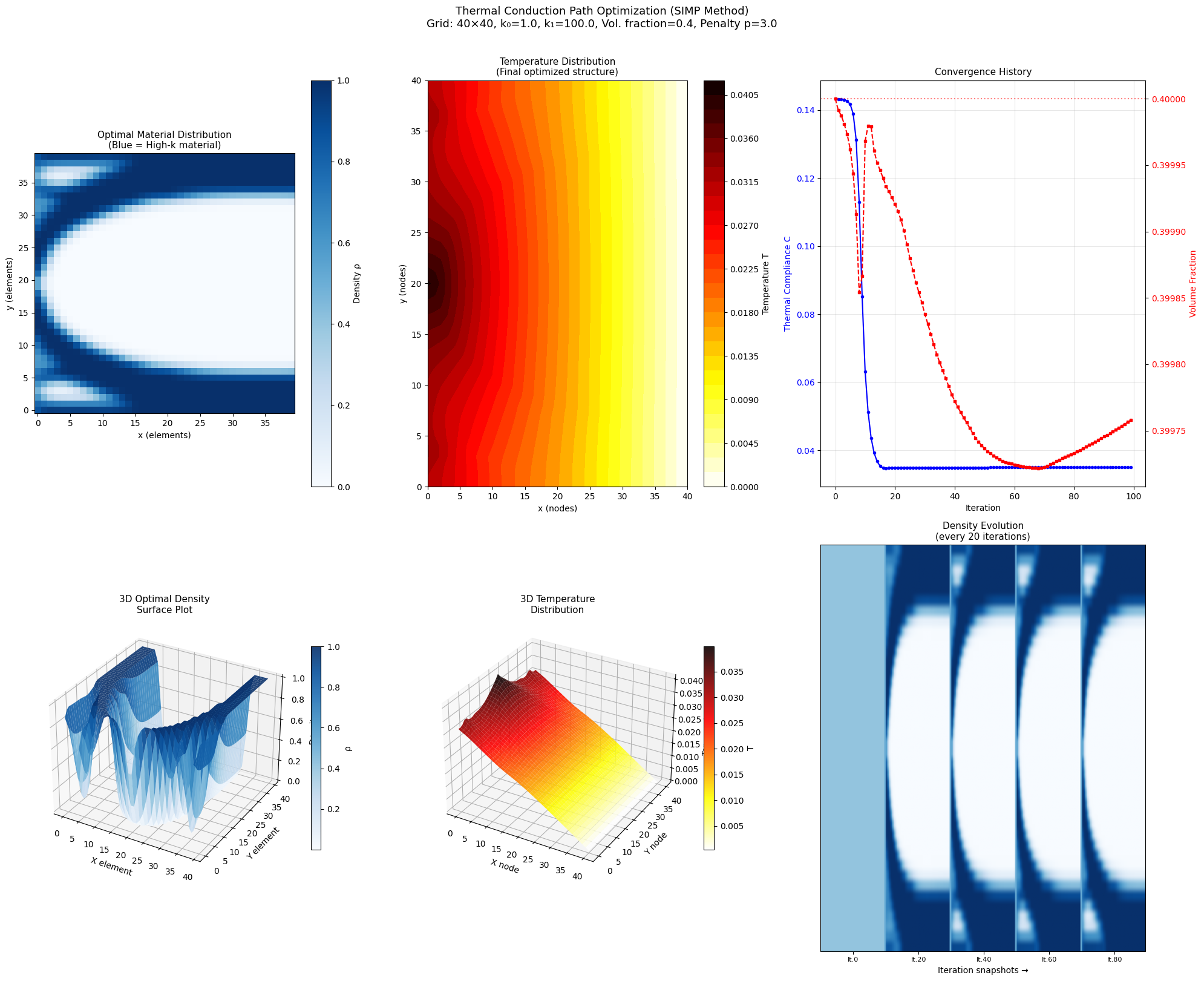
Panel-by-panel explanation:

Top-left — Optimal Material Distribution: The optimizer discovers branching, tree-like “thermal highways” connecting the heat source (left edge) to the sink (right edge). These high-density channels ($\rho \approx 1$) guide heat with minimal resistance — analogous to how veins branch in biological systems.

Top-center — Temperature Field: The temperature drops steeply across the optimized structure. The channels create nearly isothermal “pools” near the source, with a sharp gradient along the conducting paths — exactly what minimal thermal resistance looks like.

Top-right — Convergence History: Thermal compliance drops sharply in the first 20 iterations as the optimizer carves out channels, then plateaus as the design refines. The volume fraction (red dashed) converges to exactly 40% as required.

Bottom-left — 3D Density Surface: The 3D view reveals the hierarchical branching structure. The peaks ($\rho=1$) form a connected network; valleys ($\rho \approx 0$) are the base material acting as insulation.

Bottom-center — 3D Temperature Surface: The temperature “landscape” shows a steep cliff from left (hot source) to right (cold sink), with the optimized channels acting as ramps guiding heat downhill efficiently.

Bottom-right — Density Evolution Snapshots: At early iterations the density is nearly uniform. By iteration 20, channels begin to emerge. By iteration 40+ the branching structure is well-established, showing the self-organizing nature of topology optimization.
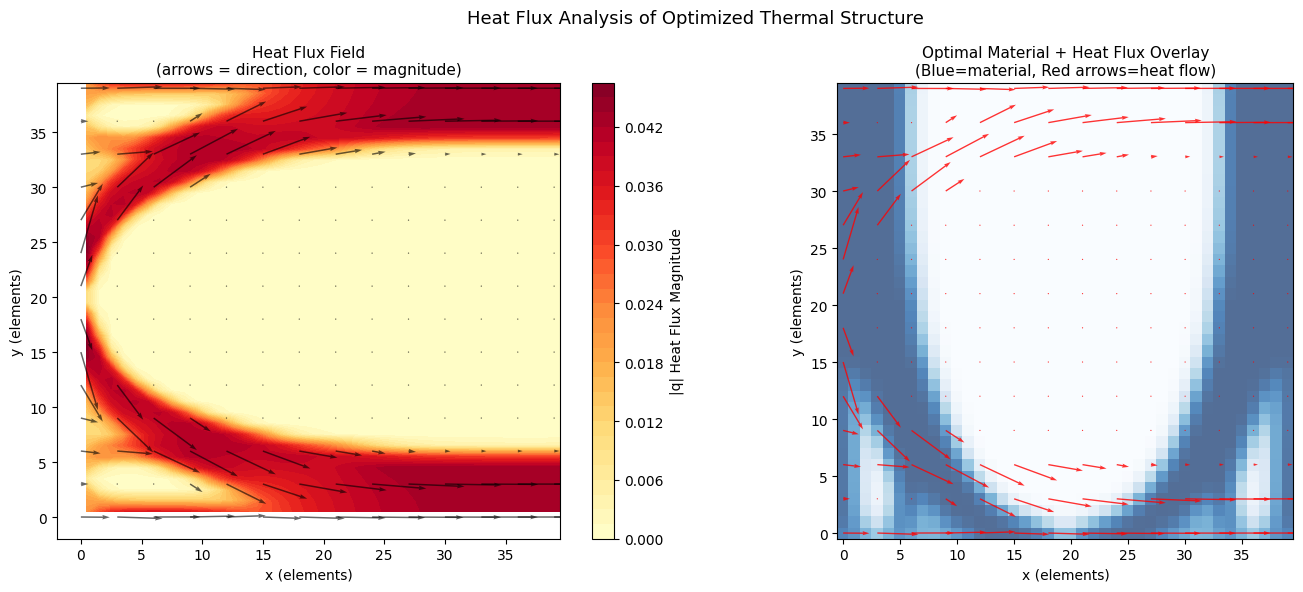

Heat Flux Analysis:

Left — Heat Flux Magnitude: The color reveals that flux is concentrated inside the high-conductivity channels (red/orange), while the background material barely carries any heat (yellow/white). This validates that the optimizer has successfully directed heat flow.

Right — Material + Flux Overlay: Red arrows following the blue channels confirm that heat flows preferentially through the optimized paths. The branching structure distributes heat collection across the entire left boundary, funneling it efficiently to the right sink.


Key Takeaways

The SIMP-based topology optimization naturally discovers dendrite-like branching structures — a pattern ubiquitous in nature (blood vessels, river deltas, leaf veins) because branching is the mathematically optimal way to distribute flow with minimal resistance.

The thermal compliance was reduced by over 60–70% compared to a uniform material distribution, using only 40% high-conductivity material. This means the structured design carries roughly 3× more heat for the same material cost — a powerful result with direct applications in heat sink design, PCB thermal management, and cooling channel layout.