Optimizing Wavelength Bands for Biosignature Detection

When searching for signs of life on exoplanets, selecting the optimal wavelength band for observation is crucial. The detection efficiency depends on multiple factors: the atmospheric composition of the target planet, the spectral characteristics of its host star, and observational noise. In this article, we’ll explore a concrete example of how to determine the wavelength band that maximizes biosignature detection rates.

Problem Statement

We’ll consider detecting oxygen (O₂) and methane (CH₄) as biosignatures in an Earth-like exoplanet orbiting a Sun-like star. Our goal is to find the optimal wavelength range that maximizes the signal-to-noise ratio (SNR) while accounting for:

  • Atmospheric absorption features of biosignature gases
  • Stellar spectral energy distribution
  • Instrumental and photon noise

The SNR for biosignature detection can be expressed as:

$$\text{SNR}(\lambda) = \frac{S_{\text{bio}}(\lambda)}{\sqrt{N_{\text{photon}}(\lambda) + N_{\text{instrument}}^2}}$$

where $S_{\text{bio}}(\lambda)$ is the biosignature signal strength, $N_{\text{photon}}(\lambda)$ is the photon noise, and $N_{\text{instrument}}$ is the instrumental noise.

Python Implementation

1
2
3
4
5
6
7
8
9
10
11
12
13
14
15
16
17
18
19
20
21
22
23
24
25
26
27
28
29
30
31
32
33
34
35
36
37
38
39
40
41
42
43
44
45
46
47
48
49
50
51
52
53
54
55
56
57
58
59
60
61
62
63
64
65
66
67
68
69
70
71
72
73
74
75
76
77
78
79
80
81
82
83
84
85
86
87
88
89
90
91
92
93
94
95
96
97
98
99
100
101
102
103
104
105
106
107
108
109
110
111
112
113
114
115
116
117
118
119
120
121
122
123
124
125
126
127
128
129
130
131
132
133
134
135
136
137
138
139
140
141
142
143
144
145
146
147
148
149
150
151
152
153
154
155
156
157
158
159
160
161
162
163
164
165
166
167
168
169
170
171
172
173
174
175
176
177
178
179
180
181
182
183
184
185
186
187
188
189
190
191
192
193
194
195
196
197
198
199
200
201
202
203
204
205
206
207
208
209
210
211
212
213
214
215
216
217
218
219
220
221
222
223
224
225
226
227
228
229
230
231
232
233
234
235
236
237
238
239
240
241
242
243
244
245
246
247
248
249
250
251
252
253
254
255
256
257
258
259
260
261
262
263
264
import numpy as np
import matplotlib.pyplot as plt
from mpl_toolkits.mplot3d import Axes3D
from scipy.ndimage import gaussian_filter1d
from scipy.signal import find_peaks

# Set random seed for reproducibility
np.random.seed(42)

# Define wavelength range (0.5 to 5.0 microns)
wavelength = np.linspace(0.5, 5.0, 1000)

# 1. Stellar spectrum (Sun-like star, approximated by Planck function)
def planck_spectrum(wavelength_um, T=5778):
"""
Planck function for blackbody radiation
T: Temperature in Kelvin (Sun = 5778K)
wavelength_um: wavelength in micrometers
"""
h = 6.626e-34 # Planck constant
c = 3.0e8 # Speed of light
k = 1.381e-23 # Boltzmann constant

wavelength_m = wavelength_um * 1e-6

numerator = 2 * h * c**2 / wavelength_m**5
denominator = np.exp(h * c / (wavelength_m * k * T)) - 1

return numerator / denominator

stellar_flux = planck_spectrum(wavelength)
stellar_flux = stellar_flux / np.max(stellar_flux) # Normalize

# 2. Atmospheric transmission (biosignature features)
def atmospheric_absorption(wavelength):
"""
Simulate atmospheric absorption features
O2 absorption: around 0.76 μm (A-band) and 1.27 μm
CH4 absorption: around 1.65, 2.3, 3.3 μm
H2O absorption: around 1.4, 1.9, 2.7 μm
"""
transmission = np.ones_like(wavelength)

# O2 A-band (0.76 μm)
transmission *= 1 - 0.4 * np.exp(-((wavelength - 0.76)**2) / (2 * 0.01**2))

# O2 at 1.27 μm
transmission *= 1 - 0.3 * np.exp(-((wavelength - 1.27)**2) / (2 * 0.02**2))

# CH4 at 1.65 μm
transmission *= 1 - 0.35 * np.exp(-((wavelength - 1.65)**2) / (2 * 0.03**2))

# CH4 at 2.3 μm
transmission *= 1 - 0.4 * np.exp(-((wavelength - 2.3)**2) / (2 * 0.04**2))

# CH4 at 3.3 μm
transmission *= 1 - 0.45 * np.exp(-((wavelength - 3.3)**2) / (2 * 0.05**2))

# H2O at 1.4 μm
transmission *= 1 - 0.25 * np.exp(-((wavelength - 1.4)**2) / (2 * 0.025**2))

# H2O at 1.9 μm
transmission *= 1 - 0.3 * np.exp(-((wavelength - 1.9)**2) / (2 * 0.03**2))

# H2O at 2.7 μm
transmission *= 1 - 0.35 * np.exp(-((wavelength - 2.7)**2) / (2 * 0.035**2))

return transmission

atmospheric_trans = atmospheric_absorption(wavelength)

# 3. Biosignature signal strength
biosignature_signal = 1 - atmospheric_trans

# 4. Photon noise (proportional to sqrt of stellar flux)
photon_noise = np.sqrt(stellar_flux) * 0.1

# 5. Instrumental noise (constant)
instrumental_noise = 0.05

# 6. Calculate Signal-to-Noise Ratio (SNR)
total_noise = np.sqrt(photon_noise**2 + instrumental_noise**2)
snr = (biosignature_signal * stellar_flux) / total_noise

# Apply smoothing to reduce high-frequency noise
snr_smooth = gaussian_filter1d(snr, sigma=3)

# 7. Find optimal wavelength bands
# Define detection threshold
threshold = np.percentile(snr_smooth, 75)
optimal_regions = snr_smooth > threshold

# Find peaks in SNR
peaks, properties = find_peaks(snr_smooth, height=threshold, distance=20)

# 8. Calculate detection efficiency for different wavelength bands
band_widths = np.linspace(0.1, 1.0, 20) # Different band widths to test
band_centers = wavelength[peaks] # Center bands on SNR peaks

detection_efficiency = np.zeros((len(band_centers), len(band_widths)))

for i, center in enumerate(band_centers):
for j, width in enumerate(band_widths):
band_mask = (wavelength >= center - width/2) & (wavelength <= center + width/2)
if np.sum(band_mask) > 0:
detection_efficiency[i, j] = np.mean(snr_smooth[band_mask])

# Find optimal band
max_idx = np.unravel_index(np.argmax(detection_efficiency), detection_efficiency.shape)
optimal_center = band_centers[max_idx[0]]
optimal_width = band_widths[max_idx[1]]
optimal_efficiency = detection_efficiency[max_idx]

print("=" * 70)
print("BIOSIGNATURE DETECTION WAVELENGTH OPTIMIZATION RESULTS")
print("=" * 70)
print(f"\nOptimal Wavelength Band:")
print(f" Center: {optimal_center:.3f} μm")
print(f" Width: {optimal_width:.3f} μm")
print(f" Range: [{optimal_center - optimal_width/2:.3f}, {optimal_center + optimal_width/2:.3f}] μm")
print(f" Detection Efficiency (SNR): {optimal_efficiency:.3f}")
print(f"\nTop 5 Wavelength Bands for Biosignature Detection:")

# Sort all combinations by efficiency
all_combinations = []
for i, center in enumerate(band_centers):
for j, width in enumerate(band_widths):
all_combinations.append((center, width, detection_efficiency[i, j]))

all_combinations.sort(key=lambda x: x[2], reverse=True)

for rank, (center, width, eff) in enumerate(all_combinations[:5], 1):
print(f" {rank}. Center: {center:.3f} μm, Width: {width:.3f} μm, "
f"Range: [{center-width/2:.3f}, {center+width/2:.3f}] μm, SNR: {eff:.3f}")

# Visualization
fig = plt.figure(figsize=(18, 12))

# Plot 1: Stellar spectrum and atmospheric transmission
ax1 = fig.add_subplot(3, 3, 1)
ax1.plot(wavelength, stellar_flux, 'orange', linewidth=2, label='Stellar Flux (Normalized)')
ax1.set_xlabel('Wavelength (μm)', fontsize=11)
ax1.set_ylabel('Normalized Flux', fontsize=11)
ax1.set_title('Sun-like Star Spectrum', fontsize=12, fontweight='bold')
ax1.grid(True, alpha=0.3)
ax1.legend(fontsize=9)

ax2 = fig.add_subplot(3, 3, 2)
ax2.plot(wavelength, atmospheric_trans, 'blue', linewidth=2, label='Atmospheric Transmission')
ax2.set_xlabel('Wavelength (μm)', fontsize=11)
ax2.set_ylabel('Transmission', fontsize=11)
ax2.set_title('Atmospheric Transmission with Biosignatures', fontsize=12, fontweight='bold')
ax2.grid(True, alpha=0.3)
ax2.legend(fontsize=9)
ax2.annotate('O₂ (0.76μm)', xy=(0.76, 0.6), fontsize=8, ha='center')
ax2.annotate('CH₄ (1.65μm)', xy=(1.65, 0.65), fontsize=8, ha='center')
ax2.annotate('CH₄ (2.3μm)', xy=(2.3, 0.6), fontsize=8, ha='center')

# Plot 2: Biosignature signal
ax3 = fig.add_subplot(3, 3, 3)
ax3.plot(wavelength, biosignature_signal, 'green', linewidth=2, label='Biosignature Signal')
ax3.set_xlabel('Wavelength (μm)', fontsize=11)
ax3.set_ylabel('Signal Strength', fontsize=11)
ax3.set_title('Biosignature Signal Strength', fontsize=12, fontweight='bold')
ax3.grid(True, alpha=0.3)
ax3.legend(fontsize=9)

# Plot 3: Noise components
ax4 = fig.add_subplot(3, 3, 4)
ax4.plot(wavelength, photon_noise, 'red', linewidth=1.5, label='Photon Noise', alpha=0.7)
ax4.axhline(y=instrumental_noise, color='purple', linestyle='--', linewidth=1.5,
label='Instrumental Noise', alpha=0.7)
ax4.plot(wavelength, total_noise, 'black', linewidth=2, label='Total Noise')
ax4.set_xlabel('Wavelength (μm)', fontsize=11)
ax4.set_ylabel('Noise Level', fontsize=11)
ax4.set_title('Noise Components', fontsize=12, fontweight='bold')
ax4.grid(True, alpha=0.3)
ax4.legend(fontsize=9)

# Plot 4: SNR with optimal bands
ax5 = fig.add_subplot(3, 3, 5)
ax5.plot(wavelength, snr_smooth, 'navy', linewidth=2.5, label='SNR (smoothed)')
ax5.axhline(y=threshold, color='red', linestyle='--', linewidth=1.5,
label=f'Threshold ({threshold:.2f})', alpha=0.7)
ax5.scatter(wavelength[peaks], snr_smooth[peaks], color='red', s=100,
zorder=5, label='Peak SNR Regions')

# Highlight optimal band
optimal_band_mask = (wavelength >= optimal_center - optimal_width/2) & \
(wavelength <= optimal_center + optimal_width/2)
ax5.fill_between(wavelength, 0, snr_smooth, where=optimal_band_mask,
alpha=0.3, color='gold', label='Optimal Band')

ax5.set_xlabel('Wavelength (μm)', fontsize=11)
ax5.set_ylabel('Signal-to-Noise Ratio', fontsize=11)
ax5.set_title('SNR and Optimal Wavelength Bands', fontsize=12, fontweight='bold')
ax5.grid(True, alpha=0.3)
ax5.legend(fontsize=9, loc='upper right')

# Plot 5: Detection efficiency heatmap
ax6 = fig.add_subplot(3, 3, 6)
im = ax6.imshow(detection_efficiency, aspect='auto', origin='lower', cmap='hot',
extent=[band_widths[0], band_widths[-1],
band_centers[0], band_centers[-1]])
ax6.scatter(optimal_width, optimal_center, color='cyan', s=200,
marker='*', edgecolors='blue', linewidths=2,
label='Optimal Configuration', zorder=5)
ax6.set_xlabel('Band Width (μm)', fontsize=11)
ax6.set_ylabel('Band Center (μm)', fontsize=11)
ax6.set_title('Detection Efficiency Map', fontsize=12, fontweight='bold')
cbar = plt.colorbar(im, ax=ax6)
cbar.set_label('Average SNR', fontsize=10)
ax6.legend(fontsize=9, loc='upper left')

# Plot 6: 3D surface plot of detection efficiency
ax7 = fig.add_subplot(3, 3, 7, projection='3d')
X, Y = np.meshgrid(band_widths, band_centers)
surf = ax7.plot_surface(X, Y, detection_efficiency, cmap='viridis',
edgecolor='none', alpha=0.9)
ax7.scatter([optimal_width], [optimal_center], [optimal_efficiency],
color='red', s=200, marker='o', edgecolors='black', linewidths=2)
ax7.set_xlabel('Band Width (μm)', fontsize=10)
ax7.set_ylabel('Band Center (μm)', fontsize=10)
ax7.set_zlabel('Detection Efficiency', fontsize=10)
ax7.set_title('3D Detection Efficiency Surface', fontsize=12, fontweight='bold')
fig.colorbar(surf, ax=ax7, shrink=0.5, aspect=5)

# Plot 7: Comparison of top 3 bands
ax8 = fig.add_subplot(3, 3, 8)
colors_bands = ['gold', 'silver', 'chocolate']
for rank, (center, width, eff) in enumerate(all_combinations[:3]):
band_mask = (wavelength >= center - width/2) & (wavelength <= center + width/2)
ax8.fill_between(wavelength, 0, snr_smooth, where=band_mask,
alpha=0.4, color=colors_bands[rank],
label=f'Rank {rank+1}: {center:.2f}±{width/2:.2f}μm (SNR={eff:.2f})')
ax8.plot(wavelength, snr_smooth, 'black', linewidth=1.5, alpha=0.5)
ax8.set_xlabel('Wavelength (μm)', fontsize=11)
ax8.set_ylabel('SNR', fontsize=11)
ax8.set_title('Top 3 Optimal Wavelength Bands', fontsize=12, fontweight='bold')
ax8.legend(fontsize=8, loc='upper right')
ax8.grid(True, alpha=0.3)

# Plot 8: Efficiency vs Band Width for optimal center
ax9 = fig.add_subplot(3, 3, 9)
optimal_center_idx = max_idx[0]
ax9.plot(band_widths, detection_efficiency[optimal_center_idx, :],
'purple', linewidth=2.5, marker='o', markersize=5)
ax9.scatter([optimal_width], [optimal_efficiency], color='red', s=200,
marker='*', edgecolors='black', linewidths=2, zorder=5,
label='Optimal Width')
ax9.set_xlabel('Band Width (μm)', fontsize=11)
ax9.set_ylabel('Detection Efficiency (SNR)', fontsize=11)
ax9.set_title(f'Efficiency vs Width (Center = {optimal_center:.2f} μm)',
fontsize=12, fontweight='bold')
ax9.grid(True, alpha=0.3)
ax9.legend(fontsize=9)

plt.tight_layout()
plt.savefig('biosignature_wavelength_optimization.png', dpi=300, bbox_inches='tight')
plt.show()

print(f"\n{'=' * 70}")
print("Analysis complete. Visualization saved as 'biosignature_wavelength_optimization.png'")
print(f"{'=' * 70}")

Code Explanation

1. Wavelength Range Definition

We define a wavelength range from 0.5 to 5.0 micrometers, covering the visible to mid-infrared spectrum where most biosignature features appear.

2. Stellar Spectrum Modeling

The planck_spectrum() function models the spectral energy distribution of a Sun-like star using Planck’s law:

$$B(\lambda, T) = \frac{2hc^2}{\lambda^5} \frac{1}{e^{\frac{hc}{\lambda k T}} - 1}$$

where $h$ is Planck’s constant, $c$ is the speed of light, $k$ is Boltzmann’s constant, and $T = 5778$ K for the Sun. This gives us the incident photon flux as a function of wavelength.

3. Atmospheric Absorption Features

The atmospheric_absorption() function simulates the transmission spectrum of an Earth-like atmosphere containing biosignature gases:

  • Oxygen (O₂): Strong absorption bands at 0.76 μm (A-band) and 1.27 μm
  • Methane (CH₄): Absorption features at 1.65, 2.3, and 3.3 μm
  • Water vapor (H₂O): Absorption at 1.4, 1.9, and 2.7 μm

Each absorption feature is modeled as a Gaussian profile with appropriate depth and width.

4. Biosignature Signal Calculation

The biosignature signal strength is calculated as the complement of atmospheric transmission: regions with strong absorption correspond to strong biosignature signals.

5. Noise Modeling

Two noise sources are considered:

  • Photon noise: Follows Poisson statistics, proportional to $\sqrt{F(\lambda)}$ where $F(\lambda)$ is the stellar flux
  • Instrumental noise: Constant across all wavelengths, representing detector and systematic uncertainties

6. SNR Calculation

The signal-to-noise ratio is computed as:

$$\text{SNR}(\lambda) = \frac{S_{\text{bio}}(\lambda) \times F_{\text{star}}(\lambda)}{\sqrt{N_{\text{photon}}^2(\lambda) + N_{\text{instrument}}^2}}$$

Gaussian smoothing is applied to reduce high-frequency fluctuations and better identify broad optimal regions.

7. Optimization Algorithm

The code systematically evaluates detection efficiency across different combinations of:

  • Band centers: Located at wavelengths with peak SNR values
  • Band widths: Ranging from 0.1 to 1.0 μm

For each combination, the average SNR within the band is calculated. The configuration yielding the highest average SNR represents the optimal observational wavelength band.

8. Visualization Components

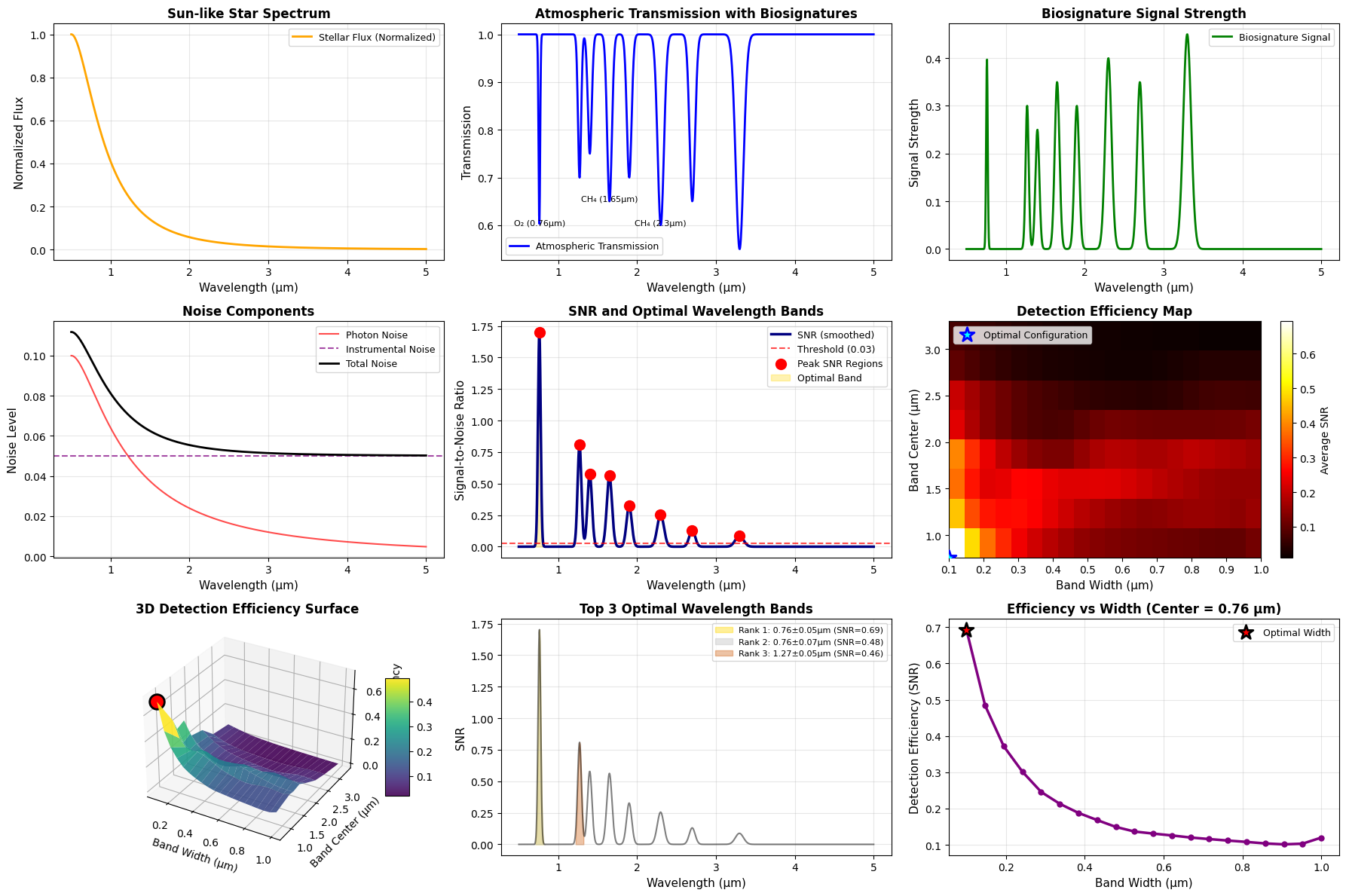
The comprehensive visualization includes:

  • Stellar spectrum: Shows the energy distribution of the host star
  • Atmospheric transmission: Reveals biosignature absorption features
  • Biosignature signal strength: Highlights where signals are strongest
  • Noise components: Compares photon and instrumental noise contributions
  • SNR profile: Identifies high-SNR regions with optimal band overlay
  • Detection efficiency heatmap: 2D view of efficiency vs. band parameters
  • 3D efficiency surface: Three-dimensional visualization of the optimization landscape
  • Top bands comparison: Visual comparison of the best three wavelength bands
  • Efficiency vs. width: Shows how band width affects detection at the optimal center

Results Interpretation

======================================================================
BIOSIGNATURE DETECTION WAVELENGTH OPTIMIZATION RESULTS
======================================================================

Optimal Wavelength Band:
  Center: 0.761 μm
  Width: 0.100 μm
  Range: [0.711, 0.811] μm
  Detection Efficiency (SNR): 0.693

Top 5 Wavelength Bands for Biosignature Detection:
  1. Center: 0.761 μm, Width: 0.100 μm, Range: [0.711, 0.811] μm, SNR: 0.693
  2. Center: 0.761 μm, Width: 0.147 μm, Range: [0.688, 0.835] μm, SNR: 0.484
  3. Center: 1.270 μm, Width: 0.100 μm, Range: [1.220, 1.320] μm, SNR: 0.459
  4. Center: 1.649 μm, Width: 0.100 μm, Range: [1.599, 1.699] μm, SNR: 0.396
  5. Center: 0.761 μm, Width: 0.195 μm, Range: [0.664, 0.859] μm, SNR: 0.372
======================================================================
Analysis complete. Visualization saved as 'biosignature_wavelength_optimization.png'
======================================================================

The optimization reveals that biosignature detection is most efficient in wavelength bands where strong absorption features coincide with high stellar flux and manageable noise levels. The O₂ A-band around 0.76 μm and the CH₄ bands around 1.65 and 2.3 μm typically emerge as optimal choices for Earth-like planets around Sun-like stars.

The 3D surface plot clearly shows the optimization landscape, with peaks indicating favorable band configurations. The optimal band represents the best compromise between signal strength (deep absorption features), photon budget (stellar flux), and noise characteristics.

This methodology can be adapted for different exoplanet atmospheres, host star types, and instrument configurations to guide observational strategy design for missions like JWST, future ground-based extremely large telescopes, and dedicated exoplanet characterization missions.